Supply Chain Attacks: The Essential 2026 Guide to Unstoppable Defense

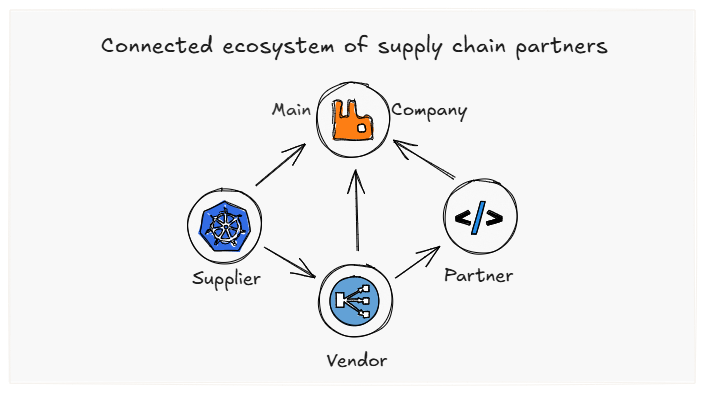
In supply chain attacks the attacker does not break into you directly. They break into a supplier, a contractor or a software vendor you already trust, and ride that trust in. In practice that means the auto-update agent on every laptop, the VPN account your managed service provider uses for support, the API key your payroll processor holds, or the npm package a developer added last year and never looked at again. Your perimeter controls let all of those through by design.
Hardening your own servers does not cover this. You need to know which partners reach what, and what it looks like when one of them is used against you. If the attacker then registers lookalike domains or fake support pages in your name, those are threats to take down too.
What is a Supply Chain?
A supply chain is every company, person and process involved in getting a product or service from its origin to the customer. Raw materials, manufacturers, logistics firms, distributors. For most businesses it also means software and service providers (vendors): SaaS tools, open-source packages pulled from npm or PyPI, cloud hosts, the outsourced IT desk.
Each of those links belongs to your extended attack surface. The attacker compromises something you consume, such as a library, a build server or a vendor’s admin account, and lets your normal processes carry the payload inside. Your systems accept it because it arrives signed and on schedule.
From one partner they can pivot to many. A managed service provider with remote management tools on hundreds of client networks is one break-in that opens a lot of doors. Security people call that spread a cascading attack. It is why supply chain attacks cost so much to clean up.

How to Spot Supply Chain Attacks
Start with the three ways in.
- Software/Code Tampering: The attacker gets into a vendor’s development, build or update pipeline and adds code to a real release. Customers install it through the normal update. In SolarWinds the tampered Orion build shipped with a valid signature, so nothing on the customer side looked wrong.
- Hardware Tampering: Rare and hard to catch. Chips, firmware or network gear are modified at the factory or in transit. Once racked, the device is indistinguishable from any other unit.
- Human/Process Exploitation: The vendor’s staff get phished. Their credentials open the distribution platform or the remote support console, and the attacker pushes updates or logs into customers directly.
Vendor Risk & Detection: How to Spot Supply Chain Attacks
- Watch for strange behaviour from trusted sources. What you are looking for is activity that a vendor account is allowed to do but never normally does. A backup agent that starts talking to an IP it has never contacted. A service account moving gigabytes at night. A config change with no ticket behind it.
- Verify what you install. Require code signing (a cryptographic check that a package came from its publisher) and ask for a Software Bill of Materials (SBOM). When the xz utils backdoor was disclosed, teams with SBOMs knew within the hour whether they shipped the affected version. Teams without them grepped servers for days. Signing alone will not save you if the build server itself was owned.
- Vendor Risk vetting has to be continuous. Before signing and throughout the contract, check how the partner actually runs security: how fast they fix reported issues, who owns security, how they control their own staff’s access. A SOC 2 report covers a past audit period. Between reports, track leaked vendor credentials, newly exposed services and lookalike domains registered against the vendor’s name.
- Put behaviour analytics on vendor accounts. AI-powered User and Entity Behavior Analytics (UEBA) learns what normal looks like per account. A vendor login from two different continents in one hour gets flagged. So does an account querying systems outside the scope in its contract.
How to Prevent Supply Chain Attacks
Write security into the contract before anyone gets access. Require least-privilege access for every vendor account, enforce Multi-Factor Authentication (MFA) on every vendor login, and keep the right to independent security testing.
Train staff on vendor impersonation specifically. People expect invoices and “urgent patch” emails from suppliers, which is exactly why attackers pose as them. During the CDK Global outage, scammers phoned dealerships pretending to be CDK support. Build phishing simulations around your real vendors and run them regularly.
Segment vendor access. Vendor remote sessions should land in an isolated zone, not on the internal network next to mission-critical systems. A compromised vendor then has to fight its way sideways, and you get time to notice.
Patch what vendors touch first. The MOVEit file-transfer breaches hit a long list of organisations through one internet-facing product they used to exchange files with partners, so jump hosts, file-transfer servers and update servers go to the top of the queue.
Ask for evidence on a deadline. Agree time-to-evidence commitments with each vendor, so after an incident they hand over timelines, takedown receipts and before/after screenshots fast enough for your auditors and insurers. We would test this during a routine review by asking for the evidence pack from their last minor incident.
Some Well-Known Supply Chain Attacks
- Of all high-profile supply chain attacks, SolarWinds (2020) is the reference case. A backdoor was compiled into a SolarWinds Orion update, and thousands of organizations installed it themselves, government agencies and large companies among them.
- CCleaner (2017): Malware was added to official CCleaner installers on the vendor’s own download servers. The tool had millions of users, and the attackers used the foothold to steal data from selected targets.
- NotPetya (2017): It started in Ukraine through a poisoned update to local accounting software, then spread worldwide. Shipping lines, drug makers and manufacturers lost systems for weeks.
Challenges and What Can Help
Detection is late because the traffic is legitimate on paper: approved partner, approved channel, valid certificate. SolarWinds’ backdoor stayed dormant for a while after installation before calling home, and its traffic imitated Orion’s own protocol.
What helps is mostly unglamorous. Keep a list of every vendor with access and what it can reach, and update it when contracts change. Ask vendors for evidence such as SBOMs, pen test summaries and incident timelines rather than filled-in questionnaires. Join your sector’s ISAC or a peer group so indicators reach you while they are still fresh, and build access so that losing any one supplier does not hand over the whole estate.
What is a supply chain attack?
Hackers go after a company’s vendors or suppliers instead of the company, then use that trusted connection to get into the company’s systems.
Can you give an example?
SolarWinds in 2020. Attackers hid a backdoor in a routine software update, and thousands of organizations worldwide installed it on their own networks.
