73 Phishing Attack Statistics for 2026 (With Sources)

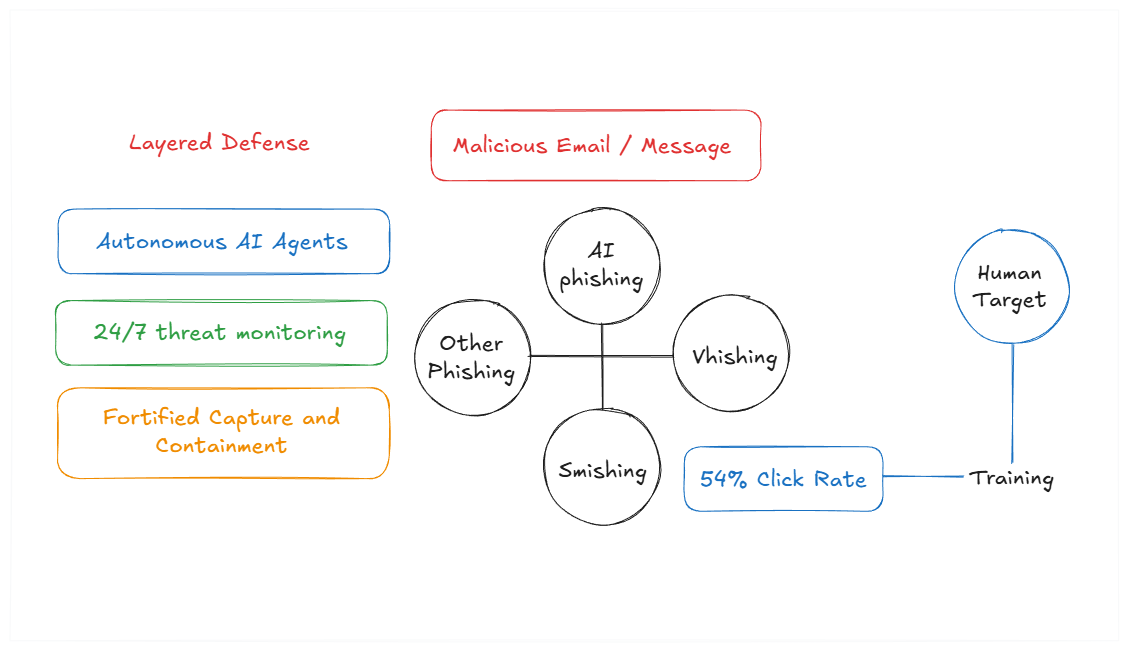
Phishing isn’t slowing down. It’s getting worse. Attackers aren’t standing still; they’re shifting tactics fast, AI-generated emails, voice phishing (vishing), SMS phishing (smishing), and brand impersonation are all on the rise, designed to fool victims and slip past security defenses. The threat has never been higher. Act now.
The numbers tell the story. As we move into 2026, you need to know the real scale of phishing. Don’t guess. Tighten your defenses where it matters.
At Hunto, we’re taking a fully autonomous AI-driven approach to tackle these evolving phishing threats. Our platform deploys 100% autonomous AI agents that continuously monitor and mitigate phishing campaigns across email, web, and social channels, even taking down malicious sites and simulating phishing attacks to train your employees.
👉 Request a demo of Hunto AI to see how our AI Phishing Simulation can strengthen your phishing defense. 💡
Key Phishing Attack Statistics for 2024-2025 (At a Glance)
Here are the numbers. They should make any security team sit up and pay attention:
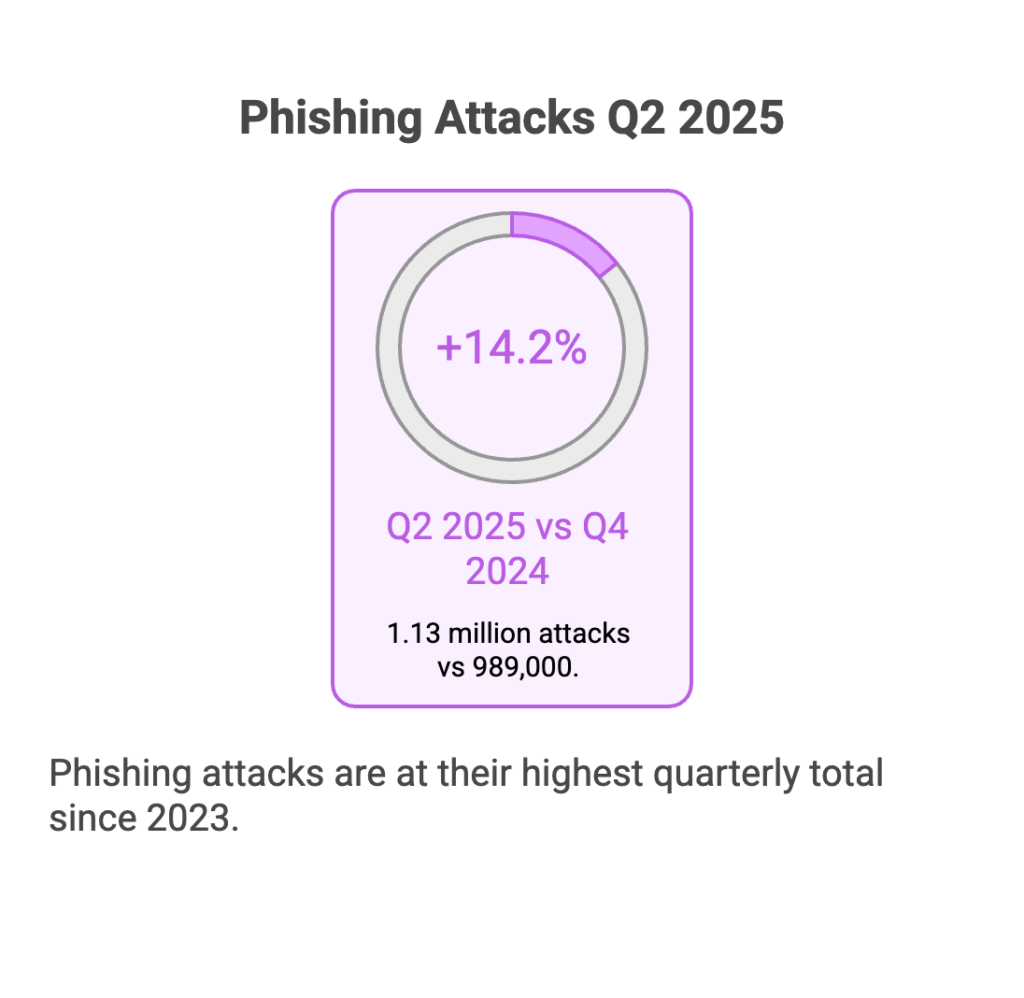
- Phishing volume rose again in 2025: The Anti-Phishing Working Group (APWG) observed 1,130,393 phishing attacks in Q2 2025, up 13% on Q1 and the largest quarterly total since Q2 2023. Q4 2024 saw 989,123 attacks. (APWG Q2 2025, APWG Q4 2024)
- Phishing leads in breach entry: Phishing was the most common initial attack vector in IBM’s 2025 Cost of a Data Breach Report, behind 16% of breaches. (IBM)
- Human error is in most breaches: Verizon’s 2026 Data Breach Investigations Report found the human element in 62% of breaches and phishing as the initial access vector in 16%. (Verizon DBIR 2026)
- Cost per breach is high: A breach that started with phishing cost $4.8 million on average, according to IBM; malicious insider attacks and third-party supply chain compromise cost slightly more. Microsoft’s 2024 Digital Defense Report cites a Trend Micro estimate that phishing had a $3.5 billion financial impact in 2024. (IBM, Microsoft)
- AI is making phishing more effective: In a controlled 2024 study, fully AI-automated spear phishing emails got a 54% click-through rate, the same as emails written by human experts and well above the 12% for generic phishing emails (Heiding et al.). KnowBe4 found that 73.8% of phishing emails it analysed in 2024 showed some use of AI, rising to 90.9% among polymorphic emails (KnowBe4). IBM reports that generative AI cut the time to write a convincing phishing email from 16 hours to 5 minutes (IBM).
- Voice phishing (vishing) is growing fast: CrowdStrike recorded a 442% increase in vishing between the first and second half of 2024. (CrowdStrike)
- Training helps reporting more than clicking: Verizon’s 2025 DBIR estimates that about 1.5% of employees in the median organisation still click simulated phishing after regular training. Employees trained in the last 30 days reported phishing at about 21%, against a 5% base rate, roughly four times as often. (Verizon DBIR)
- Microsoft is the most impersonated brand: In 2024, Microsoft appeared in 51.7% of brand impersonation phishing tracked by Zscaler ThreatLabz, ahead of Telegram, Google, Netflix and Facebook. (Zscaler ThreatLabz)
These stats only scratch the surface. There’s a lot more.
Below, we dig into 73 phishing statistics, each linked to its source, broken down by global trends, industry/region, phishing email tactics, and the rise of AI in phishing, plus what they mean for 2026 and how you can defend your organization. Read on. There’s a lot to cover.
Global Phishing Attacks Statistics and Trends (2024-2025)
Phishing remains a dominant threat vector. While overall spam volumes have fluctuated, attackers are shifting to more targeted, high-impact campaigns. The shift is real. Significant. Here are the key global phishing trends and what they mean:
- Resurgent phishing activity: APWG counted 877,536 phishing attacks in Q2 2024 and 989,123 in Q4 2024 (APWG Q4 2024), then 1,003,924 in Q1 2025 (APWG Q1 2025) and 1,130,393 in Q2 2025, a 13% quarterly jump and the largest total since Q2 2023 (APWG Q2 2025). Roughly one million attacks a quarter is the current baseline heading into 2026.
- Phishing volume down, targeting up: Zscaler ThreatLabz saw global phishing volume fall 20% in 2024, while attackers focused on fewer, higher-value targets in HR, finance and payroll teams (Zscaler ThreatLabz). Rather than casting a wide net, criminals are writing spear phishing aimed at the people with access to money or sensitive data. Expect phishing in 2026 to be more selective, not just a numbers game.
- Top reported cybercrime: Phishing and spoofing was the most reported crime type to the FBI’s IC3 in 2024, with 193,407 complaints. That is down from 298,878 in 2023, but still well ahead of extortion (86,415) and personal data breach (64,882). (FBI IC3 2024 report)
- Rising financial toll: IC3 recorded $70 million in phishing and spoofing losses in 2024, a 274% increase on 2023. Business email compromise (BEC), which often starts with a phishing email, cost victims $2.77 billion in the same year. (FBI IC3 2024 report)
- Phishing = breach entry point: In IBM’s 2025 Cost of a Data Breach Report, phishing was the most common breach entry vector (16% of breaches). That is roughly 1 in 6 breaches where a phishing email or message gave attackers their foothold, whatever malware or exploit came later. (IBM)
- Phishing fuels ransomware: Microsoft’s 2024 Digital Defense Report lists social engineering, specifically email phishing, SMS phishing and voice phishing, among the most prevalent initial access techniques in ransomware attacks. Stop the phish and you remove a common way in. (Microsoft)
- Geographic shifts: The United States is still the most targeted country, even after phishing against the U.S. dropped 31.8% in 2024, which Zscaler links to Gmail’s stricter sender rules and wider DMARC adoption. India, Germany, Canada and the U.K. followed. Phishing originating from the Netherlands grew more than 4,000% and from Hong Kong 2,000% as criminals moved hosting infrastructure. (Zscaler ThreatLabz)
- Most-imitated brands & services: Zscaler’s top imitated brands in 2024 were Microsoft (51.7%), Telegram, Google, Netflix, Facebook, OneDrive, Steam, DHL, Adobe, Instagram and Amazon. Community platforms carried a lot of it: Telegram was used in 1,119,969 phishing attacks, Facebook in 692,761 and Steam in 507,203. (Zscaler ThreatLabz)
- Emerging attack vectors: Email phishing now has company. CrowdStrike recorded a 442% increase in voice phishing between the first and second half of 2024 (CrowdStrike). SMS phishing is just as active: SecAlliance estimated that Chinese smishing operations compromised up to 115 million U.S. payment cards between July 2023 and October 2024 (Infosecurity Magazine). Phone calls, text messages, messaging apps and social media can all carry a phish.
Phishing Statistics by Industry, Company Size, and Region
Phishing campaigns aren’t one-size-fits-all. Different sectors and regions face distinct attack patterns. Here’s how phishing breaks down across industries, company sizes, and geographies:
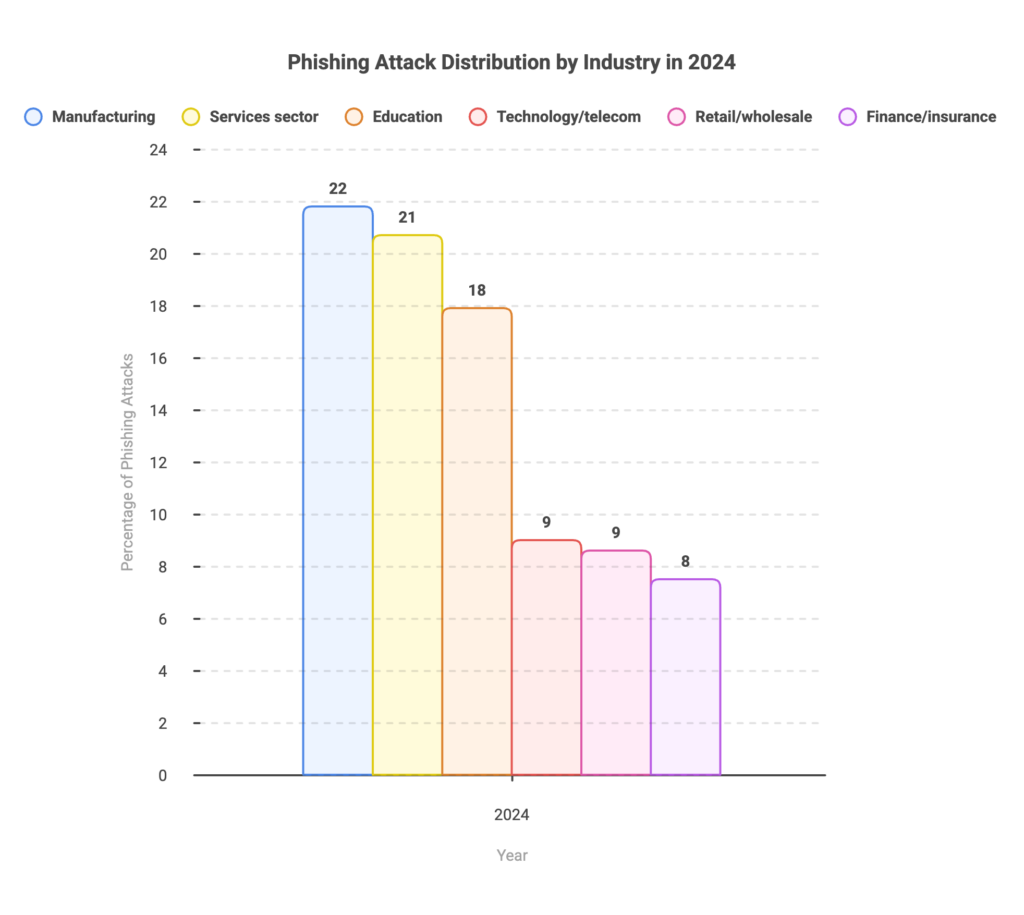
- Hard-hit industries: In 2024, manufacturing was the most targeted industry at 21.8% of phishing attacks, followed by services (20.7%) and education (17.9%). Technology (9.2%), retail and wholesale (8.6%) and finance and insurance (7.5%) had smaller shares. Phishing against manufacturing fell 16.8% but it stayed the top target, while education saw a 224% surge. (Zscaler ThreatLabz)
- Industries with declining attacks: Finance and insurance saw a 78.2% drop in phishing in 2024, and technology and communications fell 32.8%. Zscaler attributes the declines to better email filtering and authentication standards such as DMARC. Attackers went after easier targets instead. (Zscaler ThreatLabz)
- Top consumer phishing lures: In Outlook.com consumer phish reports, 54% of campaigns impersonated online software and service brands. Next came financial (15%), retail (12%), media and entertainment (11%) and freight and logistics (5%). (Microsoft Digital Defense Report 2024)
- Small vs large organizations: Social engineering, almost all of it phishing, accounted for about 18% of breaches at small and midsize businesses and 13% at large organisations in Verizon’s 2025 DBIR. Smaller firms usually have fewer controls and less IT staff, which makes them attractive targets. (Verizon DBIR)
- Regional differences: In Asia-Pacific (APAC), social engineering showed up in 25% of breaches, and phishing was involved in 26% of those, behind pretexting and prompt bombing (MFA fatigue). In Europe, the Middle East and Africa (EMEA), phishing appeared in 19% of all breaches. (Verizon DBIR 2025)
- Top countries targeted: By volume, the United States faces the most phishing of any country. The rest of Zscaler’s 2024 top ten were India, Germany, Canada, the U.K., Spain, France, Australia, South Africa and Brazil, which roughly tracks the largest economies and internet user bases. (Zscaler ThreatLabz)
- Where attacks originate: The United States is the leading origin country for phishing, followed by Germany, the U.K. and the Netherlands. The Netherlands and Hong Kong became major launchpads in 2024 after increases of more than 4,000% and 2,000% in phishing originating from their networks. (Zscaler ThreatLabz)
Phishing Email & Message Tactics (How Phishing Attacks Work)
Email is still the primary delivery method. Criminals are constantly tweaking their techniques. From QR codes to hijacked vendor accounts, here are the key numbers on how phishing attacks actually work:
- Phishing email volume trends: KnowBe4 saw a 17.3% increase in phishing emails between September 15, 2024 and February 14, 2025, compared with the previous six months. Campaigns ramped up through the holiday season, when people are distracted and systems are in flux. (KnowBe4)
- Compromised senders and supply chain attacks: Not all phishing comes from obvious bad actors. In the same period, KnowBe4 saw a 57.9% increase in attacks sent from compromised legitimate accounts, and 11.4% of those came from trusted accounts in the target’s own supply chain. Secure your own mailboxes, and watch for partner accounts being taken over. (KnowBe4)
- Phishing payloads (links vs attachments): Most phishing emails try to get the victim to click a link. KnowBe4 found that 54.9% contained a phishing link, 25.9% carried an attachment and 20% relied on social engineering alone. In attacks posing as job applications, 47% of attachments were PDFs, with ODT files at 14%, ZIP archives at 11% and DOCX or DOCM files at 11%. (KnowBe4)
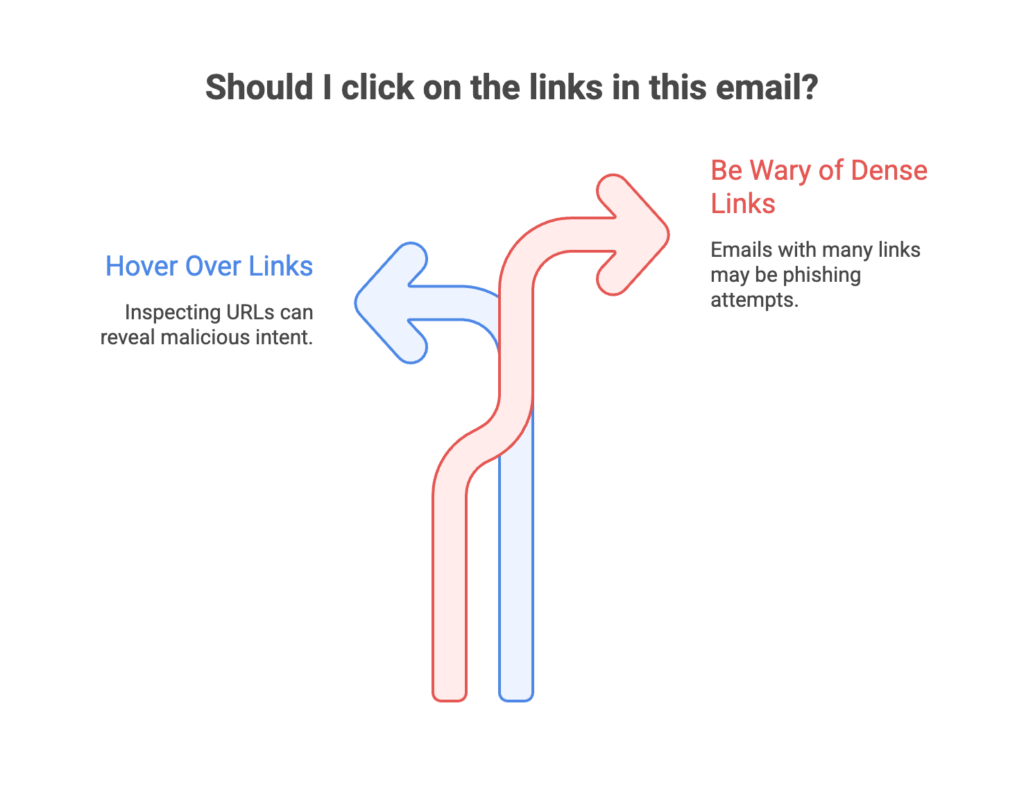
- Multiple malicious links: Phishing emails often include several links to raise the odds of a click. KnowBe4 counted an average of 3.9 hyperlinks per phishing email between September 2024 and February 2025. Hover before you click, and be wary of emails dense with buttons and “click here” links. (KnowBe4)
- Rise of QR code phishing (“quishing”): Attackers embed QR codes in emails, attachments or printed flyers. In phishing alerts from Microsoft Defender Experts, QR code phishing made up 25%, second only to phishing links (56%). Scanning a code on a phone moves the victim off the protected corporate device, which is one reason the tactic grew as link filtering improved. (Microsoft Digital Defense Report 2024)
- Legitimate platforms abused: Rather than hosting pages on suspicious domains, criminals send phishing through trusted services. The five platforms KnowBe4 saw abused most were DocuSign, PayPal, Microsoft, Google Drive and Salesforce. Because the mail comes from well-known domains, it is less likely to be blocked. (KnowBe4)
- Click rates vs. report rates: Verizon’s 2025 DBIR looked at organisations running regular training with phishing simulations. About 1.5% of employees in the median organisation keep clicking no matter how much training they get. Recent training made a much bigger difference to reporting: users trained in the last 30 days reported simulated phish at about 21%, against a 5% base rate, roughly four times as often. Prompt reporting is what contains an incident when prevention fails. (Verizon DBIR)
- Limited improvement in click susceptibility: Verizon found that each training session reduced the simulated click rate by only about 5% in relative terms. Some repeat clickers stay vulnerable, so organisations also need technical controls and an incident response plan for the click that will eventually happen. (Verizon DBIR)
The Impact of AI on Phishing (2024-2026)
Now let’s talk about email spam statistics trends 2026, spam message statistics trends 2026, and other phishing statistics.
Generative AI is changing phishing fast. Very fast. Language models can craft convincing lures at scale, and AI tools can automate tasks that once limited phishers’ reach. Here are the numbers on how AI is reshaping phishing attacks:
- Faster phishing creation: IBM says generative AI cut the time needed to write a convincing phishing email from about 16 hours to 5 minutes. Attackers can now produce polished, personalised messages quickly, which lowers the cost of every campaign. (IBM)
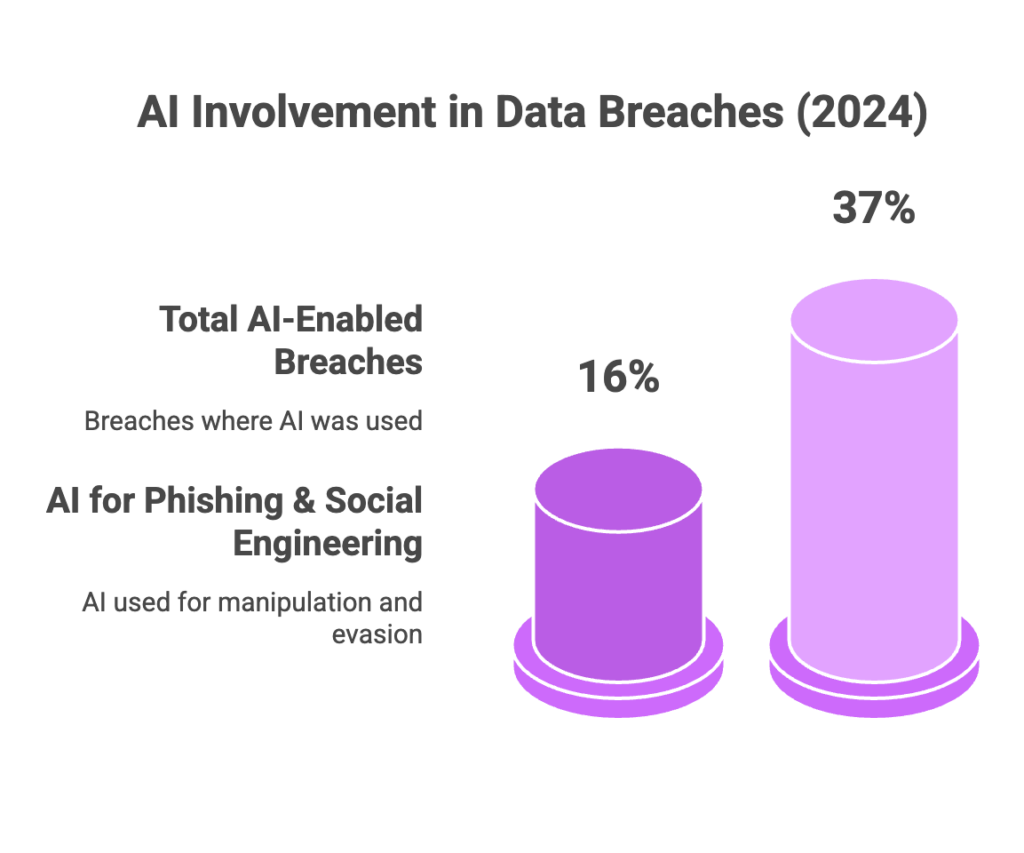
- AI involvement in breaches: In IBM’s 2025 report, 16% of data breaches involved attackers using AI. Most often that meant AI-generated phishing (37%) or deepfake impersonation (35%). (IBM)
- Polymorphic phishing at scale: Polymorphic campaigns send many variants of one email that differ in small details such as subject line, sender or URL, which makes them harder for filters to block. KnowBe4 found that 92% of polymorphic attacks used AI and that 76.4% of all phishing attacks in 2024 had at least one polymorphic feature. (KnowBe4)
- Most phishing emails now show AI fingerprints: KnowBe4 found that 73.8% of the phishing emails it analysed in 2024 showed some use of AI, rising to 90.9% for emails that also had polymorphic elements. AI is often used to polish or vary a message, not only to write it from scratch. (KnowBe4)
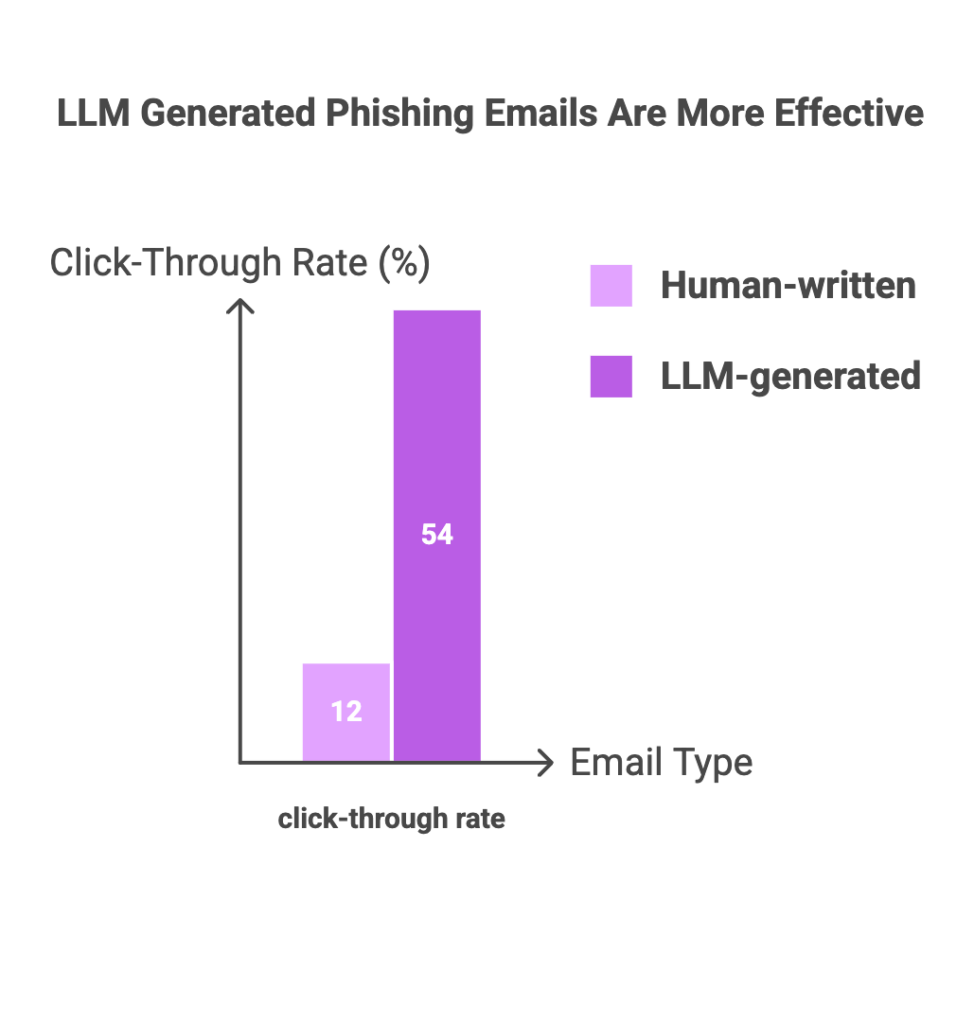
- AI-crafted emails are effective: In a 2024 study with 101 participants, Heiding, Schneier and colleagues found that fully AI-automated spear phishing emails got a 54% click-through rate, the same as emails written by human experts and 4.5 times the 12% rate for generic phishing emails. The AI tool also gathered the personal details used in each lure. (Heiding et al., arXiv)
- Deepfakes and vishing: Beyond text, AI-generated deepfake audio and video are showing up in fraud, for example cloned executive voices used to push urgent payments. IBM found deepfake impersonation in 35% of the breaches where attackers used AI. Expect more of these calls to target senior staff in 2026. (IBM)
Top 5 Takeaways for 2026 from Phishing Attack Statistics
What do all these statistics tell us? Quite a bit. Here are five key insights that organizations should act on going into 2026:
1. Phishing isn’t disappearing, it’s diversifying
Global phishing email volumes saw a modest decline in 2024, but that doesn’t mean attackers are giving up. Not at all. Phishing is splintering into new forms, voice calls, texts, QR codes, social media messages, and focusing on quality over quantity. Attackers realized that blasting millions of generic spam emails is less fruitful than a well-crafted spear phish to an HR manager. So while you might see fewer spam emails overall, expect more targeted phishing attempts that are harder to detect.
The surge in vishing and “quishing” shows phishers will use any communication channel to reach potential victims. Don’t be fooled by volume dips. Don’t relax. Phishing remains among the most common and costly attack vectors heading into 2026.
2. AI has supercharged phishing , and defenders must catch up
Generative AI is now part of attackers’ toolkits. Full stop. Phishing emails can be produced faster, in greater volume, and with higher quality than ever before. The result: AI-crafted phish that look professional and personalized. In one controlled study they drew 4.5 times the clicks of generic phishing emails. We’re also seeing AI help automate polymorphic attacks and even voice impersonation. This is an arms race, and right now, AI is giving phishers an edge.
Defenders need to use AI as well (for anomaly detection, automated threat response, etc.) to keep pace with AI-enhanced phishing. It’s that simple. The high success rate of AI-generated phish is a wake-up call that traditional training and filters alone may not be enough.
3. Security awareness training helps, but isn’t foolproof
Human error remains a huge factor in breaches. Always has been. Regular anti-phishing training matters. The good news: training significantly increases reporting rates of phishing and can reduce clicks by the most naive users. The bad news: a small percentage of users will still click no matter what, and attackers will find novel ways to trick even trained employees (especially with AI assistance).
So while you absolutely should continue phishing simulations and employee education, don’t rely on awareness alone. Pair training with technical controls that can prevent or limit the damage from that inevitable click, things like email link scanning, attachment sandboxing, web filters, and endpoint detection. Speed is everything. Have an incident response plan ready to quickly contain phishing-induced breaches, because once an attacker is in your network, time works against you.
4. High-value industries are still prime targets (even if they improved in 2024)
Manufacturing, education, healthcare, government, and finance. These sectors hold valuable data or funds, making them attractive targets year after year. Some saw declines in phishing last year (finance, manufacturing), but that’s likely because they invested heavily in security; attackers will test them again for any sign of weakness. Meanwhile, education and other less-resourced sectors saw huge increases in attacks.
The takeaway: no industry can become complacent. None. If phishing attempts against your sector dropped recently, treat it as a window to tighten your defenses, not a reason to relax. Attackers often cycle focus: if one industry gets too difficult, they’ll shift to another, but they’ll return with new tactics. Every industry must keep sharpening anti-phishing measures, especially those that handle money, personal data, or critical services.
5. Stronger security controls (and compliance mandates) are paying off
Why did phishing drop 30%+ in the U.S. and in certain industries in 2024? Better security controls. Widespread adoption of DMARC email authentication, for example, helped block billions of spoofed emails (Zscaler credits Gmail’s 2024 crackdown on unauthenticated senders with blocking 265 billion junk messages). Companies aligning to cybersecurity frameworks, like NIST, ISO 27001, or industry-specific standards, have shored up their defenses, which in aggregate makes phishing less effective and pushes attackers to try other methods.
Compliance requirements in finance, healthcare, and manufacturing now often mandate phishing training, MFA, incident response plans, and more, and we’re finally seeing the benefits in reduced attack success rates. Going into 2026, keep implementing best-practice controls. They work. As more companies adopt passwordless authentication, domain monitoring, and zero trust policies, we can collectively drive phishing success rates down. The attempts will remain frequent. But we can make them fail more often.
How to Protect Your Organization from Phishing Attacks
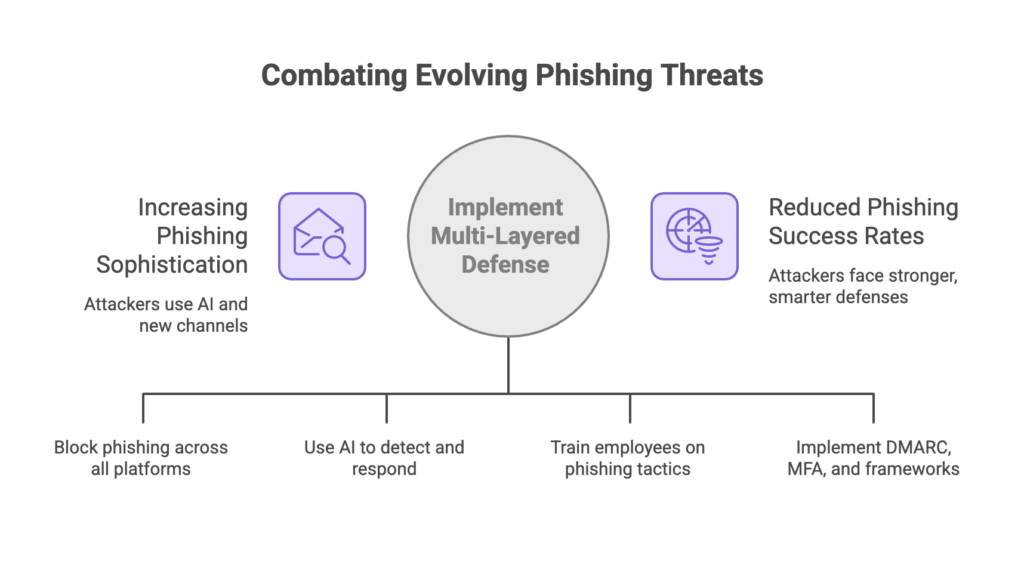
Phishing is a unique threat because it targets human behavior as much as technology. There’s no silver bullet. A layered defense strategy is the only realistic answer. Based on the latest trends, here are the most effective measures to defend against phishing in 2026 and beyond:
1. Regularly train and test your employees
Make security awareness an ongoing effort. Don’t make it a one-off. Provide frequent training on phishing indicators (suspicious sender addresses, urgent language, unexpected attachments, etc.) and update staff on new phishing tactics. Run simulated phishing campaigns to keep employees on their toes, this turns training from theory into practice.
Make security awareness an ongoing effort. Provide frequent training on phishing indicators (suspicious sender addresses, urgent language, unexpected attachments, etc.) and update staff on new phishing tactics like AI-generated emails or voice scams. Run simulated phishing campaigns to keep employees on their toes, this turns training from theory into practice.
Focus additional training on high-risk roles like finance, HR, and executives, who are often targeted in spear-phishing. Encourage a culture of “when in doubt, report it.” Every employee should know how to quickly report a suspected phishing email or call to IT/security. The goal isn’t blame. It’s fast reporting to contain threats. Celebrate employees who catch phish in simulations or real life. Positive reinforcement makes the lessons stick.
2. Implement strong email and identity security
Email is the entry point. Lock it down. Enable phishing-resistant multi-factor authentication (MFA) on all accounts, especially email and VPN access, so that a stolen password alone won’t let an attacker in.
Modern phishing can even hijack some MFA (via “MFA fatigue” or rogue prompts). So consider phishing-proof methods like FIDO2 security keys or mobile push MFA with number matching. Deploy email security gateways and cloud email security add-ons that filter out spam, scan links and attachments, and use AI to detect phishing content. Enforce protocols like DMARC, SPF, and DKIM to prevent spoofing of your domain, and pay attention to DMARC reports to see who’s trying to impersonate your email.
On the identity side, adopt the principle of least privilege. If one account is compromised via phishing, it shouldn’t have broad access to everything. Regularly review user access. Disable accounts that are no longer needed. One set of stolen credentials shouldn’t automatically equate to a total breach.
3. Establish a rapid incident response plan
Assume a phishing attack will slip through. Plan for it. Preparation is key to minimize damage. Have clear procedures for what happens when an employee reports a phishing email or falls victim (e.g. clicked a link or opened a bad attachment). Your plan should include: immediate isolation of the affected machine or account, password resets for compromised users, an analysis of the phishing email (to see if malware was installed or data was sent out), and notification of your incident response team. Every step counts. Don’t skip any.
Speed matters. Phishing breaches can go unnoticed for months, but if you catch the signs within hours, you can prevent a full-blown data breach. Conduct drills of your incident response, and ensure contacts (IT, legal, communications) are up-to-date so you can respond quickly. Time lost figuring out “who do I call?” is opportunity gained for the attacker. A well-practiced cyber incident response plan can turn a potential crisis into a contained event. That’s the goal.
4. Use advanced tools, automation, and AI
Given the volume and quality of phishing today, technology is your force multiplier. Use it. Consider deploying automated phishing detection and response solutions: systems that automatically quarantine emails deemed suspicious (containing known malicious links or spoofed headers), or browser isolation that opens unknown links in a sandbox. Use AI-driven security tools that analyze email patterns and user behavior to flag anomalies, an AI system might catch that a login page (though hosted on a benign domain) is harvesting credentials, or that a normally quiet account just sent 500 identical emails (indicating a compromised account sending phish).
Threat intelligence and brand monitoring services can alert you if your company’s name or domains are being used in phishing campaigns, so you can act (website takedowns, for instance) to protect your customers. Automation is also important for speed: set up rules or playbooks so that when a phishing email is reported, the system can automatically search all mailboxes and remove any copies, blocking the sender across the organization. The faster you stamp out a phishing spread, the better. AI isn’t just for attackers. Use it on your side too. Use it to strengthen your defenses, from email filtering to user education (e.g. AI-based phishing simulators that tailor exercises to each employee’s weaknesses).
5. Harden your infrastructure and supply chain
Phishers often exploit technical weaknesses and third parties, not just humans. Shore up the infrastructure and ecosystem around your users. Implement web content filtering and DNS security so that even if a user clicks a phishing link, it gets blocked or redirected to a warning page. Keep software updated. Keep systems patched. Some phishing emails carry malware that exploits known vulnerabilities, so an unpatched PC can turn a phish click into a ransomware incident. Use browser and email client settings to disable auto-running of macros or downloads, reducing the harm if someone opens a malicious attachment.
Additionally, extend your phishing defenses to your supply chain and partners: communicate with vendors about spoofing risks, share threat intelligence where possible, and encourage them to use MFA and good email hygiene. Your vendors are your attack surface too. If you rely on a third-party service (like payroll or CRM), ask about their anti-phishing measures and incident response, an attack on a supplier can quickly become your problem (as happened in supply chain phishing cases where a vendor’s email was hijacked). By hardening your overall ecosystem, not just your own network, you make it much harder for phishers to find a foothold. That’s the goal.
Defending against phishing requires a coordinated, always-on approach. That’s what Hunto is built for. We help organizations put many of the best practices above into action faster and more effectively through automation and AI:
- Continuous phishing monitoring and takedown: Hunto’s platform uses autonomous AI agents to scan the web, email, and social media for phishing threats targeting your brand or employees. When a phishing site or attack is identified, our system initiates takedown procedures immediately. Neutralizing fake sites and rogue domains before they trap more victims.
- AI-driven phishing simulation and training: Hunto provides an AI Phishing Simulation module that sends realistic simulated phish to your users, adapting to each user’s behavior and skill level. This keeps your team sharp and identifies who might need extra training. Our micro-training content then educates those users on the specific red flags they missed, resulting in measurable improvement in your human risk score.
- Integrated email protection and DMARC enforcement: We make it easy to deploy phishing-resistant email authentication (DMARC/DKIM/SPF) with our DMARC+ solution, strengthening your email channels against spoofing. Hunto also integrates with your email platforms to provide advanced filtering and warning banners on external emails, adding an extra layer of protection right in users’ inboxes.
- Threat intelligence and rapid response: Hunto’s Threat Intelligence engine consolidates phishing indicators from across our network and global feeds. If there’s a new phishing campaign or tactic emerging (say, a wave of QR code emails or a fresh Microsoft 365 credential phish), our platform alerts you in real-time and can automatically update blocks and policies to defend against it. ?
Our AI agents work 24/7, so you have a tireless ally watching for attacks and responding instantly, even at 3 AM on a holiday.
6. Most common spam email domains 2026
These domains show up in spam reports constantly. It’s not that the domain itself is malicious, but spam email addresses using these domains are often flagged:
- gmail.com, a common free provider abused by spammers to mask identity
- outlook.com / hotmail.com, free Microsoft domains widely used by spam senders
- gmx.com / inbox.lv, free email providers flagged in spam lists
- mail.ru, Russian free email domain often seen in spam data
Free email services are often used legitimately, but spammers exploit them because they’re easy to set up and hard to block universally.
Disposable & Throwaway Spam Domains
Spammers frequently use temporary or throwaway domains that exist only briefly, to evade filters. They come and go fast. Some spotted on spam domain lists include:
- mail-address.live
- mail-apps.com / mail-apps.net
- mail-cart.com
- mail-easy.fr
- mail-fake.com
- mail-hub.info
- mail-list.top
- mail-pro.info
- mail-temp.com
These domains typically lack strong reputation or authentication (SPF, DKIM) and are often listed on blocklists. Block them early. Don’t wait.
With Hunto’s agentic, effortless threat management approach, you can stay ahead of phishing attackers without overburdening your security team. We handle the heavy lifting. Smart automation discovers threats, enforces protective controls, and remediates incidents fast. The result is fewer successful phishes, less dwell time, and greater peace of mind.
🔒 Ready to fortify your phishing defenses for 2026?
Request a demo of Hunto AI today and let our autonomous AI agents show you how to outsmart phishing attacks, before they reach your users. Together, we can turn the tide against phishing and build a more resilient security posture for your organisation.
Checkout how Hunto AI has helped 100+ customers protect their organisation from cyber threats.
Phishing techniques keep evolving. Staying current isn’t optional. It’s the baseline. The data throughout this article makes one thing clear: phishing threats are real, they’re growing in quality, and organizations that don’t adapt will pay for it. Use these insights to understand where you’re exposed and what to fix first. Prioritize. Act.
Focus additional training on high-risk roles like finance, HR, and executives, who are often targeted in spear-phishing. Encourage a culture of “when in doubt, report it.”
Keep all software and systems updated and patched, some phishing emails carry malware that exploits known vulnerabilities, so an unpatched PC can turn a phish click into a ransomware incident. Use browser and email client settings to disable auto-running of macros or downloads, reducing the harm if someone opens a malicious attachment.
Additionally, extend your phishing defenses to your supply chain and partners. Share threat intelligence. Encourage vendors to use MFA and good email hygiene.
If you rely on a third-party service (like payroll or CRM), ask about their anti-phishing measures. An attack on a supplier can quickly become your problem.
Harden your overall ecosystem. Don’t just focus on your own network. That’s a mistake. You make it much harder for phishers to find a foothold.
Stay vigilant. Keep adapting. New tactics emerge constantly. Phishing attack statistics keep shifting, and so do the attackers.
FAQs on Phishing Attack Statistics
What are the latest phishing attack statistics for 2026?
Phishing is the most reported cybercrime type in FBI IC3 data, with 193,407 complaints in 2024, and the most common breach entry point in IBM’s 2025 Cost of a Data Breach Report. APWG observed more than one million phishing attacks in each of the first two quarters of 2025, and voice phishing grew 442% in the second half of 2024 according to CrowdStrike. AI is also making phishing emails more convincing.
How common are phishing attacks compared to other cyberattacks?
Phishing is the most reported crime type to the FBI’s IC3, with 193,407 complaints in 2024. In IBM’s 2025 Cost of a Data Breach Report it was also the most common initial attack vector, behind 16% of data breaches.
What industries are most targeted by phishing attacks?
Industries most targeted by phishing attacks include:
Financial services
Technology and SaaS
Healthcare
Government and public sector
Retail and eCommerce
Phishing attack statistics show that attackers focus on industries handling sensitive credentials, payments, or customer data.
How much do phishing attacks cost businesses?
IBM’s 2025 report puts the average cost of a breach that started with phishing at $4.8 million. The FBI’s IC3 recorded $2.77 billion in business email compromise losses in 2024. On top of direct theft, phishing brings downtime, regulatory fines and reputational damage.
Are phishing attacks increasing every year?
What percentage of phishing emails are generated using AI?
KnowBe4 found that 73.8% of phishing emails it analysed in 2024 showed some use of AI, and 90.9% of those with polymorphic elements. AI-written messages are more personalised and grammatically clean, and in one controlled study fully AI-automated spear phishing performed as well as emails written by human experts.
Why are phishing statistics important for cybersecurity planning?
Phishing statistics help organizations:
Identify high-risk attack vectors
Allocate security budgets effectively
Improve incident response planning
Measure training and detection effectiveness
Understanding phishing attack data is important for building a proactive security strategy. It’s the starting point.
What are the biggest phishing trends to watch in 2026?
Key phishing trends for 2026 include:
AI-generated spear phishing
Voice cloning for vishing attacks
QR code phishing (quishing)
Cloud identity and OAuth abuse
Business Email Compromise (BEC) growth
These trends reflect a shift from volume-based attacks to high-value, targeted phishing campaigns. Pay attention to all five. Each one matters.
