10 Best Use Cases for AI Agents in Cybersecurity: The Future of Digital Defence
The existing and widely adopted approach to cybersecurity is no longer effective in the age of AI. According to the World Economic Global Security outlook report 2025, 72% of the respondents say the number of cyber attacks have risen in the past year. Many newer attacks can be attributed to AI.
Security teams are burnt out, experiencing alert fatigue while trying to tackle these increased attacks as well as higher number of false positives. The attackers are moving faster than the security teams can, and existing methods simply cannot keep up with modern AI powered cyber attacks.
Enter the AI Agent in Cybersecurity.
AI Agents are not standard automations or tools that just follow a set script. Agents are intelligent software that act like a team member who lives in the cloud. AI Agents in cybersecurity observe what is happening, make a decision, and take action to stop a threat without human prompting.
If you want to know how this technology is actually being used in the USA right now, you are in the right place. Here is a look at the real-world impact of AI Agents.
Traditional Security vs. Autonomous AI Agents: A Comparison
Let’s compare how AI Agents in cybersecurity perform in comparison to the older ways of doing cybersecurity operations:
| Feature | The Old Way | The AI Agent Way |
| Mindset | Wait for an alert (Reactive) | Go find the threat (Proactive) |
| Speed | Humans take hours or days | AI takes milliseconds |
| Logic | Follows strict rules | Makes smart decisions |
| Coverage | Guards the front door | Guards the entire house |
What Are AI Agents in Cybersecurity? (Understanding Agentic AI)
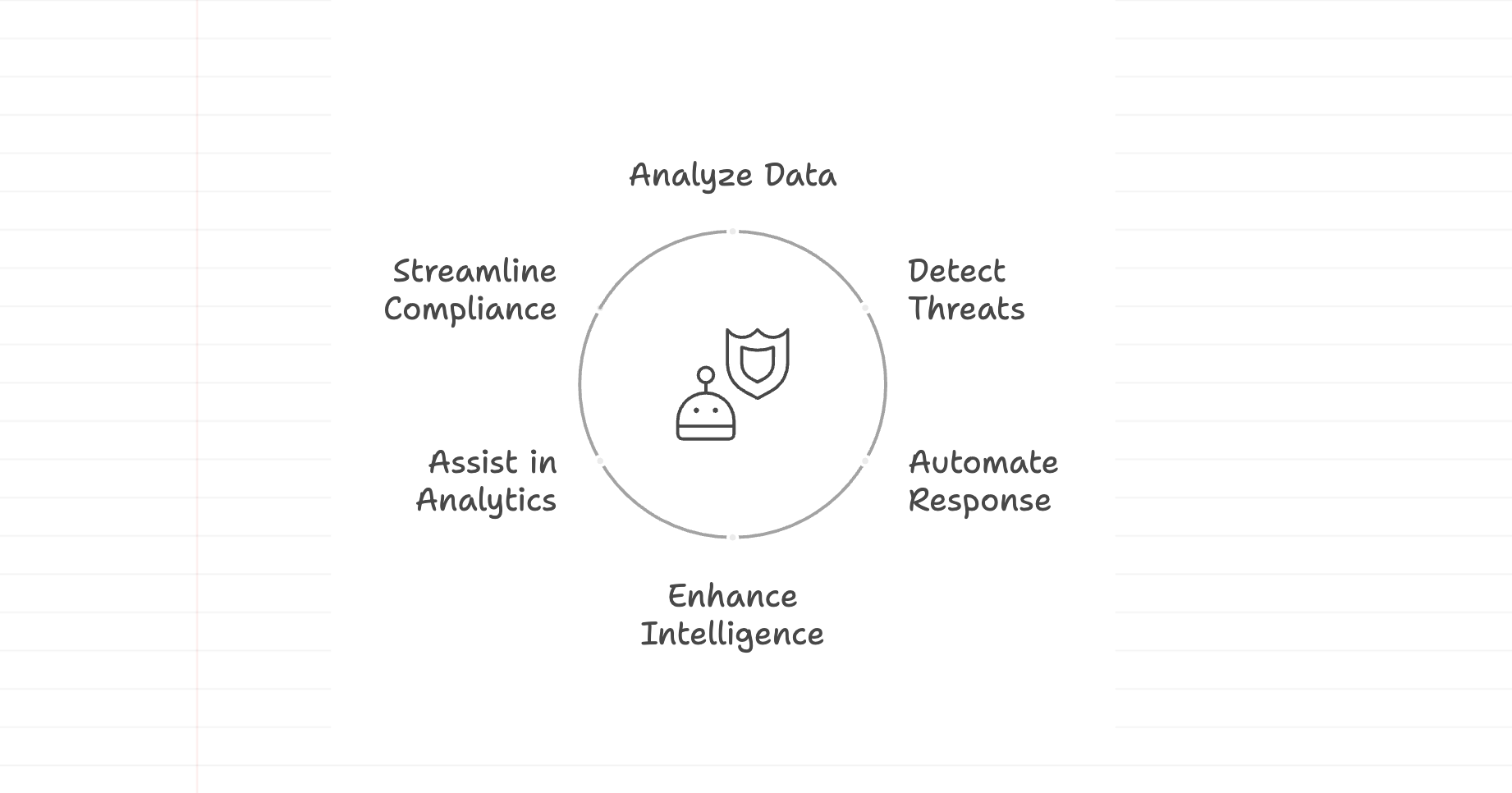
Think of an AI Agent as a tireless employee who never sleeps, never drinks coffee, and never complains about working weekends. In the world of cybersecurity, these agents are built to handle specific jobs. Unlike basic generative models that just produce text, Agentic AI systems execute multi-step operations aligned with security objectives.
According to leaders in the space like IBM, leveraging AI in security allows for vastly improved threat detection and response times compared to traditional rule-based systems. Specialised agents work independently to keep your data safe, allowing your human team to focus on big picture strategy.
5 Key Advantages of Deploying AI Agents for Cybersecurity
Before diving into the specific use cases, it is crucial to understand why US companies are rapidly adopting this technology. It goes beyond simple automation; it is about reaching a level of safety that humans alone cannot achieve.
1. Combatting Alert Fatigue with Automated Triage
This is arguably the biggest benefit. Security Operations Centres (SOCs) are flooded with thousands of alerts daily. Most are false alarms. Human analysts get “alert fatigue” and start ignoring warnings, which is when real threats slip through. AI agents filter through the noise, investigating low-level alerts autonomously and only escalating genuine threats to human teams.
2. Achieving Hyper Scale and Speed with AI Security Agents
A human analyst might take thirty minutes to investigate a suspicious IP address. An AI agent can investigate thirty thousand IP addresses in seconds. When dealing with a massive attack surface, the ability to scale defence operations instantly is vital. Agents analyse vast datasets across global networks far faster than any human team could ever dream.
3. Ensuring 24/7 Continuous Threat Monitoring and Response
Hacking attacks are not limited to business hours. Usually, in those times when there are fewer workers on shifts, like holidays or weekends, hackers make their moves. In fact, AI agents allow for a real 24/7 monitoring and reaction system. Just like human beings, they do not need rest or sleep; therefore, even if it is late at night or the weekend, the security measures are still in place.
4. Shifting from Reactive to Predictive Defence with AI
Traditionally, security measures are only put in place once a breach attempt is detected. However, advanced AI agents employ machine learning to figure out the patterns that lead to an attack. In fact, by identifying these signals of trouble at their very early stages, they help an organisation to move from a reactive posture to a predictive one, thus preventing threats from making any kind of damage.
5. Bridging the Cybersecurity Skills Gap with AI Automation
The cybersecurity industry faces a massive shortage of millions of skilled professionals. It is hard to hire enough qualified people to man a full SOC. AI agents act as a force multiplier, allowing a small team of analysts to perform with the efficiency of a massive team.
10 Real World Use Cases of AI Agents in Cybersecurity
Here is how organisations are using these systems, such as Hunto AI’s specialised cybersecurity AI agents, to stay ahead of hackers.
1. Autonomous Threat Hunting and Detection
Most security tools sit and wait for a bell to ring. AI Agents are different. They actively patrol your network looking for trouble. They analyse massive amounts of data to find the “needle in a haystack” that a human analyst would miss. By using Hunto AI Autopilot, teams catch silent attackers hiding in the noise.
2. Next Gen Phishing Detection and Simulation Training
Phishing remains a primary entry point for attackers. Agencies like CISA (the Cybersecurity and Infrastructure Security Agency) emphasise that phishing is a top threat facing US organisations.
- Defence: Agents read incoming emails to check for urgent language or sender anomalies.
- Training: They generate realistic fake phishing emails to test employees safely, helping teams learn to spot real scams.
3. Automated Incident Response and Threat Containment
When ransomware hits, every second counts. You do not have time for manual approval. Platforms like Hunto AI use agents to act instantly.
- The Action: If a laptop acts suspiciously and begins encrypting files, the agent cuts its internet connection immediately.
- The Win: The infection stops spreading before it ruins the entire network.
4. AI-Driven Identity and Access Management (IAM) Security
Passwords get stolen all the time. Modern AI Agents look at behaviour instead of just credentials to verify identity.
- The Scenario: If a user logs in from New York and then logs in from London ten minutes later, the agent identifies this “impossible travel”.
- The Win: It locks the account right away, stopping hackers even with the correct passwords.
5. Intelligent Vulnerability Management and Prioritisation
You probably have thousands of software bugs in your network. You cannot fix them all at once. AI Agents scan your software and tell you which ones actually matter to hackers right now. They prioritise patches based on real-world risk rather than just a generic severity score.
6. Automated Cloud Security Posture Management (CSPM)
Setting up cloud servers on AWS or Azure is complicated. One wrong setting can leave your data open to the world. Agents watch your cloud configurations like a hawk, looking for drift from secure baselines. If a storage bucket is accidentally left public, the agent closes it automatically.
7. Rapid Malware Analysis and Reverse Engineering via AI
When a new, unknown virus appears, understanding it takes time. AI Agents speed this up by running the virus in a safe sandbox environment. They observe which files the virus touches and which servers it contacts, generating a detailed report in minutes.
8. Continuous Autonomous Red Teaming and Penetration Testing
The best way to find a hole is to attack it yourself. AI Agents simulate a real hacker in a continuous autonomous red teaming operation. They try the same evolving tricks criminal groups use to find your weak spots before a real criminal does.
9. AI-Powered Continuous Compliance Monitoring and Auditing
Keeping up with strict laws like GDPR, CCPA, or HIPAA is a headache. Agents check your logs and system settings continuously to ensure you are always following legal guidelines. When auditors come, your reports are already ready, saving hundreds of hours.
10. Real-Time DevSecOps and Automated Code Security
Developers make mistakes. AI Agents act like a “spell check” for security code during the development process. As a developer writes code, the agent analyses it and suggests security fixes in real time. This stops vulnerabilities from ever reaching your live product.
Agentic AI Architectures for Cybersecurity: The Manager Worker Model
How are these agents built for testing defences? The gold standard right now for autonomous operations is the Manager Worker Architecture.
| The Role | The Job |
| The Manager | This agent is the boss. It looks at the target organisation, devises a high-level attack plan, and instructs others on what to do. |
| The Worker | These agents do the heavy lifting. One might run a port scan while another tries to crack a password. |
| The Reporter | This agent takes all findings and writes a clean, understandable report for the human user. |
Industry Spotlight: How AI Agents are Securing the Banking Sector
Banks are the biggest targets for cybercriminals, so they have to be the smartest defenders.
- Fraud Detection: Banks use AI to watch millions of transactions. If spending patterns look unusual, the agent freezes the card instantly.
- Money Laundering: Criminals move money through thousands of accounts. AI Agents track these webs to find patterns humans simply cannot see.
The Future of AI in Cybersecurity: Autonomous Defence vs. AI-Powered Attacks
What comes next? We are moving toward fully Autonomous Defence. In the near future, security systems will be self-healing. An AI Agent will detect an attack, patch the vulnerability, and update firewall rules for the entire company without you ever lifting a finger.
However, hackers have AI too. The future of cybersecurity will be a battle between their AI and ours. The side with the best data and the fastest agents will win.
Frequently Asked Questions (FAQs)
How can generative AI be used in cybersecurity?
Generative AI is great for training. It can write fake phishing emails to test your staff or generate code to help fix security bugs. It also acts as a smart assistant, summarising complex threat data into simple English for analysts.
How is AI used in cybersecurity?
It is used to automate the hard work that is manual, boring, or time consuming and doesn’t justify human intervention. It handles threat detection, responds to attacks, and analyses data. It allows teams to process huge amounts of information to find threats that manual methods miss.
How is AI used in cybersecurity for banks?
Banks use it mostly to stop fraud. It monitors transactions in real time to spot suspicious spending. It also helps track money laundering schemes by analysing relationships between different accounts.
What is the future of AI in cybersecurity?
The future is fully autonomous agents. These systems will be able to find and fix breaches on their own. We will also see a rise in AI-powered attacks, which means our defences need to be sharper than ever.
What are agentic AI architectures for cybersecurity penetration testing?
The most popular one is the “Manager Worker” model. A central planner agent breaks down the attack goal into small tasks, and worker agents execute these tasks using specific tools. It is efficient and scalable.


