 By Madhurendra·Reviewed by Madhurendra·February 17, 2026·Updated August 11, 2026·23 min read·AI Agents
What Are AI SOC Agents and How Do They Work?
Modern Security Operations Centers (SOCs) are drowning. Alerts pile up. Skilled analysts are scarce. AI SOC Agents offer a new answer: autonomous, AI-driven systems that act as virtual Tier-1 analysts. They don’t follow rigid, rule-based scripts or static playbooks. Instead, an AI SOC agent “reasons through problems, adapts to new situations, and works continuously without human intervention”.
In practice, that means the agent ingests alerts from your SIEM and EDR, gathers context (threat intelligence, user data, logs), and triages and investigates incidents in plain language. It’s essentially a human analyst running at machine speed.
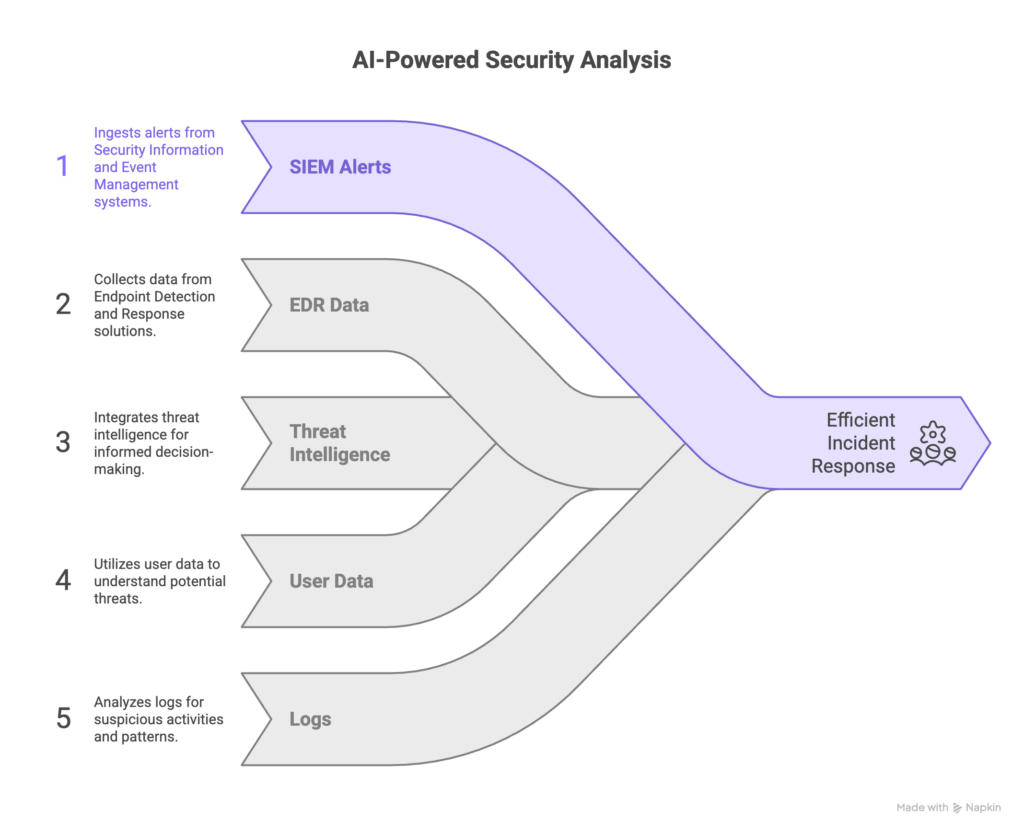
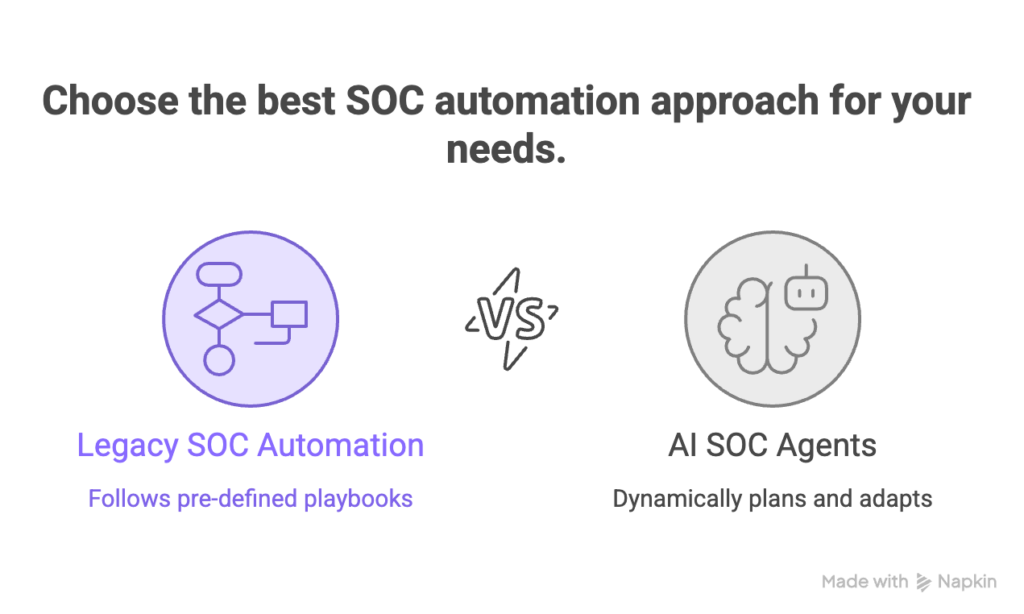
An AI SOC agent takes over the repetitive alert triage and enrichment that normally bogs down analysts, freeing them for strategic, high-value work. Unlike legacy SOC automation (SOAR) that follows pre-defined playbooks, AI agents use agentic AI models to plan dynamically, adapt, and explain themselves. The result: agents cut noise, surface real threats, and carry out basic response actions on their own. All with transparent reasoning.
How AI SOC Agents Differ from Traditional SOC Automation
Adaptive reasoning vs. rigid rules: Traditional SOC tools (SIEM, SOAR) run on static rules or playbooks. They do exactly what they’re programmed to do. Novel scenarios break them. AI SOC agents use advanced machine learning and natural language models that reason through each alert in context. They handle edge cases without anyone writing new rules to cover them.
Continuous learning vs. one-time setup: SOAR automations are hand-coded. They need repeated maintenance. AI agents keep learning from new data and analyst feedback instead. Their decisions improve and adapt over time to match your organization’s environment and threat patterns.
Proactive investigation vs. reactive execution: SOAR is reactive by design. It waits for an alert and runs a fixed workflow. AI agents take a different approach. They trigger on all incoming alerts and can launch their own queries (hunting IOCs, for example) without waiting for a scripted next step. That lets them surface subtler threats and correlated signals that rigid automations would miss entirely.
Natural-language output vs. technical logs: Traditional tools produce tickets or logs that analysts must interpret on their own. AI agents translate findings into plain, readable summaries. They explain why they called an alert benign or malicious. Analysts get an audit trail and the context they need to act.
AI SOC agents are a fundamentally different category from traditional automation. They’re autonomous “thinking” tools. Not just “doing” tools. As industry experts put it, agentic AI “builds a chain of logic to explain why an alert matters, or doesn’t, before an analyst ever sees it” with no manually coded playbooks required. That shift delivers the efficiency and coverage SOAR promised but rarely provided.
AI SOC Agent Architecture & Capabilities
AI SOC agents run on a modern, distributed architecture built for speed and scale. Traditional SOCs funnel everything through a central SIEM. Analysts bounce between tools. AI-driven architecture breaks that pattern. An AI agent platform connects directly to your data sources and tools (EDRs, identity systems, cloud logs, and so on) rather than relying on a central SIEM alone. This “AI-native” model creates a unified control plane: agents ingest and process data in parallel, applying intelligence close to the source.
Think of an AI SOC agent as a team of specialized micro-agents (Agent Swarms) working together. Each agent has a narrow focus. One handles endpoint triage. Another handles identity alerts. A central orchestration engine routes alerts to the right agent. Those agents then query multiple tools and databases at once, spanning SIEMs, EDR/endpoint systems, identity directories, and threat intelligence feeds. This distributed, agentic architecture eliminates the old “swivel-chair syndrome” where analysts flip between dozens of consoles.
Key architectural features include:
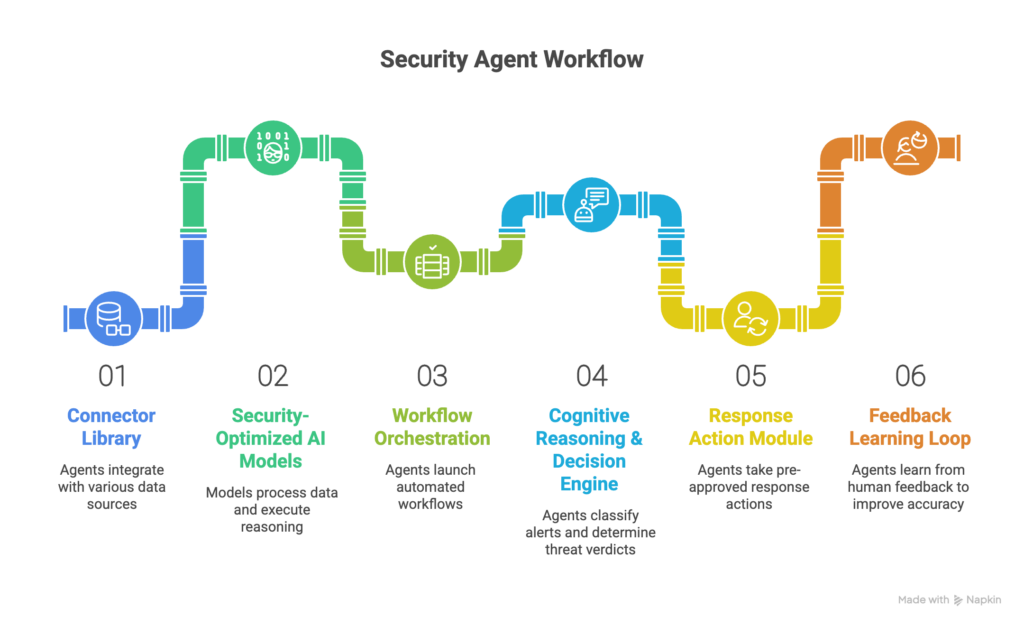
Connector library: Agents pull data from SIEMs (Splunk, Microsoft Sentinel), EDR platforms (CrowdStrike, SentinelOne, Defender), email systems, identity providers (Azure AD, Okta), and threat intel sources via out-of-the-box integrations and APIs. They also push results into ITSM and chat tools (ServiceNow, Jira, Slack) to create or update tickets without any manual handoff.
Security-optimized AI models: At their core, agents run LLMs or machine learning models fine-tuned for security contexts. These models parse logs, process threat intelligence, and reason over evidence. They typically include a knowledge base of CVEs, MITRE ATT&CK, and organizational policy rules to ground decisions in real context.
Workflow orchestration: On an alert trigger, the agent launches a workflow of automated steps. They’re dynamic, not hard-coded. The agent might fetch a process tree from the endpoint, query a threat hash on VirusTotal, check the user’s role in Active Directory, and pass all of that context to its reasoning engine. The whole chain runs automatically.
Cognitive reasoning & decision engine: Using specialized security LLMs, the agent reasons over gathered facts to classify the alert. It weighs business context (a finance user running admin scripts is more suspicious than an IT user doing the same) and arrives at a verdict: benign, suspicious, or malicious.
Response action module: When confidence is high, the agent can take pre-approved response actions automatically. Isolate a host. Disable a user account. Block an IP address. All actions are logged for audit.
Feedback learning loop: After handling an alert, the agent learns from human feedback. If an analyst corrects a decision, that correction retrains the agent’s models. Accuracy improves with each cycle.
This flexible, agentic architecture lets AI SOC agents analyze data faster than any single tool or human team. Processing is spread across multiple AI modules, each querying a different part of the security stack at the same time. According to industry reports, this turns a SOC into an always-on, data-driven operation: agents investigate threats “instantly, without breaks, and in parallel,” something human teams simply can’t match.
Core Functions: Triage, Investigation, Enrichment & Decision-Making
AI SOC agents do four things well. Each maps to Tier-1 analyst duties. Machine speed, though.
Alert Triage:
The moment an alert fires (say, an endpoint flags suspicious behavior), the agent ingests it from the SIEM or EDR. It categorizes the alert type (email, endpoint, cloud, and so on) and enriches it with context right away. That initial triage includes tagging severity and priority. The agent also filters out obvious false positives immediately. A security update triggered the alert? Closed. A known benign script ran? Closed.
Vendors report auto-closing 50-80% of false alarms through intelligent triage like this. That clears the queue. Analysts only deal with what matters.
Contextual Investigation:
If an alert needs a closer look, the agent launches a multi-source investigation. It queries multiple data sources in parallel, spanning endpoints, network logs, cloud services, identity management systems, and more. It might retrieve the process tree of a suspicious process, check the hash on VirusTotal, look up the user’s recent activity, and search for related events in the SIEM. Specialized security LLMs then correlate and reason over all those findings together.
This mirrors what a human analyst does when building an incident timeline. The agent reconstructs the attack path. It identifies lateral movement if any exists. It scopes the blast radius. If an event connects to a known campaign or CVE, that insight goes in as enrichment. The result is a detailed investigative dossier for each alert. A fast analyst would struggle to compile it manually in the same timeframe.
Threat Intelligence Enrichment:
Throughout an investigation, AI agents pull in external intelligence automatically. They check IP and domain reputations, scan for malicious signatures, and cross-reference indicators of compromise (IOCs) from threat feeds. Suspicious executable? The agent queries malware databases and threat intel platforms. It also applies organizational context: it knows that if the affected asset is a critical database server, the alert’s priority should be higher. By layering threat intel on top of business context, the agent makes sure decisions are well-informed. The agent fills in the blanks before any human sees the case, delivering a fully enriched incident package (logs, user and asset info, reputation scores) directly on the ticket.
Decision-Making and Action:
Once all the evidence is in, the agent makes a call. Its reasoning engine classifies the alert as benign, suspicious, or malicious. That decision weighs both technical signals and business factors. In one example, the agent notes: “User is marketing staff, but running admin scripts…” and “Hash matches known Emotet variant.” High confidence. Real threat. If the verdict is malicious, the agent escalates to higher-tier analysts with a recommended action. If benign, it auto-closes (“Auto-Close”) and documents why. The agent explains its reasoning in plain language every time. Each verdict comes with a natural-language summary (for example, “False positive, routine task, no malicious behavior found”), so the logic is never a mystery.
Where confidence is very high and policy permits, the agent acts immediately: isolate the host, block the IP, disable the account. Otherwise, it updates the ticketing system or SIEM with findings and a recommendation. The end result: every alert has a clear, documented outcome. Closed as noise. Escalated as genuine. All relevant evidence attached.
AI SOC agents automate the full alert-handling workflow: ingestion, triage, enrichment, investigation, decision, and reporting. They do this around the clock and in parallel across thousands of alerts. Specialized reasoning. Machine scale. Consistent every time.
Integration with the Existing Security Stack
AI SOC agents build on top of your current tools. They don’t replace them. Deploying an agent means connecting it to your SIEM, EDR, identity platform, and other sources so it can ingest alerts and query data. As Gartner notes, AI agents “sit on top of the tools and data you already run.” Most solutions ship with prebuilt connectors. A typical SOC Analyst Agent integrates with SIEMs like Splunk, Azure Sentinel, or Sumo Logic; EDRs such as CrowdStrike Falcon, SentinelOne, and Microsoft Defender; and ITSM/ticketing systems like ServiceNow, Jira, or Zendesk. Email gateways, cloud logs, vulnerability scanners, threat-intel platforms. Context is pulled automatically.
That tight integration means the AI agent can both read from and write to your existing security tools. It consumes alerts from your SIEM or EDR via webhooks (Step 1 in Hunto’s workflow) and writes back findings, updating a ticket in ServiceNow or annotating the alert record. Disconnected tools become a unified, AI-driven process.
Integration isn’t entirely plug-and-play, though. It takes planning. You need to make sure the agent gets timely access to the right data streams and alert feeds. That may mean flattening some silos (forwarding cloud and network alerts into the SIEM) and verifying APIs or connectors. Once that setup is done, the agent draws on the broadest possible intelligence. It pulls in threat intel feeds, checks asset inventories, and uses identity lookups to inform each investigation. It might query who an alert’s user is, what groups they belong to, or whether their account has recently been flagged.
AI SOC agents are designed to augment, not replace, your security stack. They work alongside SIEMs, EDRs, identity systems, cloud services, threat intel databases, and ticketing channels. Your existing tools keep delivering value. Alerts still come from your SIEM or EDR, but an AI agent now handles them automatically using the data those tools already provide.
Business Benefits of AI SOC Agents
Deploying AI SOC agents changes a security operation in ways you can measure. Here’s where it shows up:
Faster Response and Detection
AI agents cut mean time to detect (MTTD) and respond (MTTR) sharply. A human analyst might average 30 minutes per alert triage. An agent does it in seconds. Agents run 24/7 and handle multiple alerts at the same time. Threats get escalated or contained far more quickly. One vendor reports cutting triage time from 30 minutes to 30 seconds per alert. Others describe going from weeks of backlog to near-real-time coverage.
Massive False Positive Reduction
By automatically weeding out benign alerts, agents cut noise dramatically. Industry case studies show agents resolve 50-99% of alerts automatically as false positives. One company reached 95-99% reduction in false alarms after deploying agentic triage. That’s not a typo. Analysts spend far less time on dead-end alerts. Fewer false positives mean the team can focus on what’s real. As Prophet AI summarizes, agents “filter through massive alert volumes, suppress false positives, and surface the most critical threats.”
Analyst Productivity & Workload Relief:
With the repetitive work offloaded, human analysts concentrate on higher-value activities: threat hunting, incident strategy, detection tuning. Burnout drops. Turnover drops. Gartner specifically notes that AI SOC agents let “security teams handle more operational work with the same team,” extending human capacity without adding headcount. Junior analysts also ramp up faster: when AI agents handle the simple cases, the learning curve flattens out.
Consistent, Auditable Investigations:
Unlike manual triage, agents follow documented procedures every time. That consistency helps with auditability and compliance. Each alert investigation produces a written summary and evidence package in the ticket system. Stakeholders and auditors can see exactly why the agent made a decision. No “analyst A vs. analyst B” variation. Hunto’s agent, for example, ensures every investigation “follows the same rigorous process.”
Scalability and Coverage
An AI agent doesn’t fatigue. It reviews all alerts, including the low-priority ones humans often skip. Nothing falls through the cracks. If an attack floods the queue, the AI scales throughput dynamically. Coverage goes from partial to 100%.
Faster Analyst Training:
New hires ramp up faster. AI agents supply the reasoning. A junior analyst reviewing an agent’s output sees a complete analysis rationale and learns from it directly. Over time, the agent holds institutional knowledge that would otherwise live only in experienced heads. Gartner calls this “built-in capture of institutional knowledge” that doesn’t walk out the door when someone leaves.
Strategic Focus & ROI:
Senior talent freed from routine work can spend more time on detection tuning, threat hunting, and improving defenses. Doing more with the same resources translates to clear ROI. Some vendors cite cost savings in the millions; one homepage claims roughly $5M+ in savings per enterprise through automation gains. Even without that specific number, the return is real: faster threat response, fewer breaches, and lower headcount pressure.
AI SOC agents deliver measurable business gains: speed, scale, and consistency. They improve key SOC KPIs like MTTD and MTTR. False-positive rates drop. Team morale goes up. Security leaders get something concrete to show for their investment.
AI SOC Agents vs. Traditional SOC Tools
Here’s how AI agents stack up against the legacy tools most SOCs already run:
AI SOC Agent Vs SIEM:
A SIEM collects logs and generates alerts. It doesn’t make decisions or take actions. AI agents augment SIEMs by automatically consuming those alerts. The SIEM says “here’s an event.” The agent takes the next step: it interprets the alert, enriches it, and decides what to do. The agent sits on top of your SIEM and multiplies what it can do.
AI SOC Agent Vs SOAR:
Traditional SOAR platforms automate based on fixed playbooks. They’re good at simple, scripted tasks (notifying on a known phishing alert, for instance), but they don’t reason. AI agents replace those brittle workflows with intelligent reasoning. Prophet Security puts it plainly: unlike SOAR, agentic AI “adapts on its own without manual rules or intervention” and delivers efficiency that SOAR never reached.
SOAR might require a defined playbook for a “new user login alert.” An AI agent already understands user behavior baselines and catches anomalies without explicit rules. Most organizations have found that SOAR under-delivered on the lights-out SOC promise. Legacy SOAR “struggled with the more complex, judgment-driven ‘thinking’ tasks,” as one analysis puts it. AI SOC agents tackle exactly those thinking tasks.
AI SOC Agent Vs Manual Tier-1
In a traditional SOC, Tier-1 analysts manually triage alerts using playbooks or checklists. It’s slow. It’s error-prone. An AI agent automates that entire Tier-1 role autonomously, acting as a 24/7 Tier-1 analyst. Agents don’t fatigue or get distracted. They process many alerts at once.
They’re also faster. Where humans might spend several minutes piecing together context, agents have enriched data ready in seconds. Human analysts move from “alert ferrymen” to actual incident investigators.
AI SOC Agent Vs Threat Hunting:
Traditional threat hunting is periodic and human-driven. AI agents run continuously in the background, applying ML models to find anomalies on the fly. Threat detection becomes proactive rather than scheduled.
AI SOC agents complement and extend existing tools. Think of them as an intelligent layer atop your SOC stack. They work with SIEM, SOAR, EDR, and other tools rather than replacing them outright, but they transform what those tools achieve by injecting AI-driven reasoning into the process.
Limitations & Common Misconceptions
AI SOC agents are powerful. But they’re not magic. Here’s what to watch for:
Not a Drop-in Human Replacement:
A common fear is that AI agents will make SOC analysts obsolete. They won’t. Agents are built to augment analysts, not replace them. They handle repetitive alert triage. But human judgment is still needed for nuanced decisions and containment. Gartner explicitly frames these agents as an assistant, not a replacement. Leaders must maintain oversight and accountability. In practice, organizations use AI agents to offload low-level work so analysts can focus on strategy, complex incidents, and cases that need human insight.
Data Quality and Integration Need:
AI agents depend on the quality and breadth of available data. Sparse telemetry? The agent’s effectiveness suffers. Successful deployments require clean, well-integrated logs, alerts, and context feeds. Garbage in, garbage out still applies. One expert guideline: start with high-fidelity alert sources for the initial deployment, then expand gradually.
Transparency & Trust:
Some teams worry about “black box” decision-making. Fair concern. AI agents from reputable vendors are designed to be transparent: they explain the “why” behind each decision. During evaluation, make sure any agent you test provides clear explanations (listing the key evidence that led to a malicious verdict, for example). Keep humans in the loop at the start. Many teams run AI agents in shadow mode initially, where the agent makes decisions quietly while humans review them, just to build trust. Verify and validate the agent’s findings on a regular schedule.
False Positives & Hallucinations:
AI cuts false alarms, but it’s not perfect. Models can misclassify, especially on very unusual scenarios. That’s why ongoing testing and continuous feedback matter. Review samples of agent-closed cases. When errors turn up, retrain or tune the agent. It’s also wise to have a fallback: if confidence is low, the alert defaults to human review. Vendors often build in confidence scoring to decide when to auto-respond versus when to page a human.
Complex Licensing and Cost:
Pricing is a real consideration. AI SOC agents are still a new category. Vendors may price per-alert or per-investigation. Model your expected alert volume and usage before signing anything. The productivity gains typically far outweigh licensing fees, but you need a budget plan going in.
Maturity and Market Variation:
This is an emerging space (recently recognized by Gartner and others). Product maturity varies widely. Some solutions are little more than security-directed chatbots. Others, like Hunto or Prophet, provide fully autonomous workflows with verified case outputs. Evaluate any agent against real-world use cases in your environment. Ask for case studies or proofs-of-concept that show actual SOC improvements, not just slides.
AI SOC agents aren’t a silver bullet. They come with caveats. With proper implementation and oversight, though, their advantages can far outweigh their limitations.
Treat AI agents as governed infrastructure:
- implement safeguards,
- monitoring, and
- human review to manage any new risks they introduce.
Hunto AI and Its SOC Analyst Agent
Hunto AI is building out AI SOC agents alongside various AI Agents for cybersecurity. Hunto’s solutions cover a range of tasks (risk monitoring, takedown, and more). The flagship offering is the Hunto SOC Analyst Agent: an autonomous Tier-1 analyst.
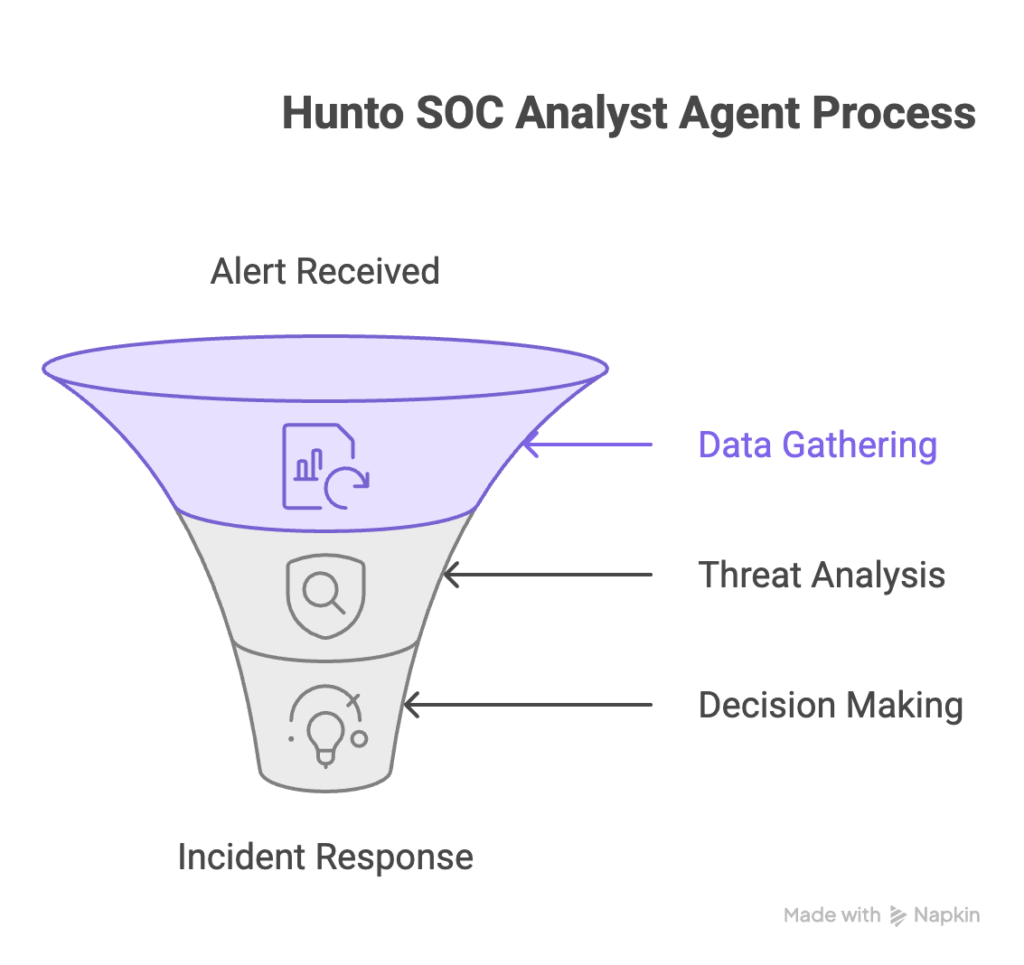
The SOC Analyst Agent from Hunto is a “Tier-1 Autonomous SOC Analyst” that automates alert triage and investigation. It integrates with leading SIEMs (Splunk, Sentinel, and others), EDR platforms (CrowdStrike, SentinelOne, Microsoft Defender), and ticketing systems (ServiceNow, Jira) as needed.
When an alert comes in (say, “Suspicious PowerShell execution on Host X”), the Hunto agent jumps into action. It queries multiple sources at once (endpoint data, user identity info, network logs) to gather facts the same way a human analyst would. It checks IP and domain reputation, examines the process tree on the host, and pulls threat intelligence on any matching hashes. It even reviews user history to see if that user regularly runs such scripts. Then specialized security LLMs think through the evidence.
For example, it might reason: “Is this admin user running a routine script on schedule? Likely a false alarm. New script from a random temp folder? Likely malicious.” Each hypothesis drives a decision.
The output from Hunto’s agent is transparent. It classifies the alert and acts: either auto-closes it as a false positive or escalates it as a genuine threat. If labeled malicious, the agent escalates the case (#4921) and tags it with MITRE ATT&CK techniques (for example, “T1059 Lateral Movement”). It also generates a human-readable investigation summary for Tier-2 analysts. That summary covers all key findings and reasoning, so a human reviewer can get up to speed quickly.
Capabilities of Hunto’s SOC Analyst Agent include:
Autonomic Triage:
The agent auto-closes the majority of low-value alerts, reportedly cutting alert volume by 80%+ by filtering out false positives.
Contextual Enrichment:
Before presenting a case to an analyst, it gathers all relevant data (logs, reputation scores, user context) so no one has to pull that context manually.
Decision Transparency
Every classification comes with a plain-language explanation. The agent states explicitly why it judged an alert as benign or malicious.
Automated Response Actions
When it’s highly confident and policy allows, the agent executes containment: isolating an infected host or disabling a compromised account, for example.
Continuous Learning:
The agent learns from feedback. When analysts overrule a decision, the system uses that correction to refine its models.
In practice, Hunto’s SOC Analyst Agent can cut triage time from roughly 30 minutes to roughly 30 seconds per alert. It covers 100% of alerts. No low-priority cases get skipped. Organizations handle far higher alert volumes without adding headcount. That automation “alleviates alert fatigue” and guarantees every alert gets investigated.
It connects with popular SOC tools and delivers clear, actionable output. That shows how an AI agent can be deployed in a live environment to produce the speed and consistency SOC teams actually need.
Frequently Asked Questions (FAQ)
Will AI SOC Agents replace our human analysts?
No. Think of agents as smart assistants, not replacements. Experts are clear that AI agents are built to augment the SOC team, not eliminate it. They take over repetitive triage, which frees your analysts for high-value work (hunting, strategy, complex incidents). By cutting burnout and freeing up time, agents often make the human analysts’ contributions more impactful. “Today’s capabilities of AI SOC agents are not a replacement for human operators” is the consistent message across the industry. Human judgment and oversight stay essential.
How can we trust an AI agent’s decisions?
Trust comes from transparency and validation. Leading solutions provide glass-box explanations for every decision. For each alert, the agent outputs not just “yes/no” but a rationale: what signals it found and why it drew that conclusion. Analysts can audit the logic directly.
During deployment, many teams run the agent in parallel with humans (shadow mode) to verify accuracy. Continuous review and tuning are essential. Analysts always have final say and can override any agent decision. Keep detailed logging and an audit trail for all agent actions so you can trace and trust what it’s doing.
Will the agent make mistakes or “hallucinate”?
AI isn’t perfect. Agents can misclassify, especially on novel or ambiguous scenarios. That said, they typically catch subtle indicators a person might miss, so overall error rates tend to fall. Top solutions include confidence thresholds: if the model isn’t highly confident, the case goes to a human.
To manage mistakes, monitor agent performance metrics on an ongoing basis. If false negatives or positives start slipping through, feed that back into the system. The agent learns from corrections and gets more accurate over time.
How do we integrate an AI agent into our SOC?
Integration generally means connecting the agent to your alert and data sources via APIs or webhooks. Most AI agent platforms offer native connectors to common tools (Splunk, Sentinel, CrowdStrike, ServiceNow, Jira, and similar). You’ll need to configure those so alerts flow into the agent and so the agent can query context (pulling user info from an identity store, for example).
Good integration planning matters: make sure your SIEM and log systems capture the data the agent needs (network logs, process logs, cloud logs, and so on). If your data is distributed, you may need to set up streaming or forwarding so the agent has a unified view. Initial setup takes work, but once it’s done the agent automatically uses those connections for every alert.
How much does it cost, and is it worth it?
Pricing models vary by vendor (per alert, per investigation, and so on). What matters is the ROI in analyst time saved and breaches avoided. Look at metrics like analyst hours reclaimed and faster incident containment. Many organizations find the cost quickly offset by efficiency gains (reducing headcount growth or reassigning expensive SOC engineers to more strategic work, for instance).
Pilot a small scope first to measure impact on your own KPIs (alert reduction rate, MTTD, MTTR) before a full rollout.
Can AI agents handle all types of alerts?
Modern agents cover a wide range: endpoint (EDR) alerts, cloud/Azure/AWS alarms, identity/authentication alerts, email/phishing reports, network IDS events, and more. In the examples above, agents triage everything from suspicious login attempts to malware detections to unusual process activity. They work best on digital alerts where data is structured.
For highly unstructured cases (social engineering incidents, for example) human analysts still perform better. Vendors are expanding coverage rapidly, adding specialized email and phishing agents, so that gap is narrowing.
What kind of oversight do we need?
Human oversight is non-negotiable. Keep senior analysts in the loop, at least at the start. That can mean requiring human sign-off for any automated actions, or regularly sampling the agent’s closed cases for quality control. Also build a process for updating the agent’s logic: whenever a new threat type emerges or a false positive slips through, feed that back to improve the agent. Good governance (clear policies on what the agent can do, performance reporting, and so on) keeps the system accountable. Treat the AI agent as critical infrastructure: set up alerts for its failures and maintain logs for audit compliance.
Is this just hype, or are organizations actually using AI SOC Agents?
It’s early, but it’s real. Gartner has recognized AI SOC Agents as an “Innovation Trigger” on its 2025 Hype Cycle. Leading-edge SOCs have started trials and production deployments. Several cybersecurity companies (7AI, Prophet Security, Hunto AI, Intezer, Red Canary) now offer commercial AI SOC platforms.
Early case studies report strong gains (95% false positive reduction, triage times cut by 99%). Caution and due diligence still matter, but AI SOC agents are moving from concept into practical use in environments that take security seriously.
AI SOC Agents are designed to accelerate and standardize your SOC workflow, not to remove humans from the loop. Understand their strengths, plan around their limitations, and you can deploy these agents to meaningfully improve your security operations.


