What is SIEM? 5 SIEM Tools and 10 Core Features (2026 Guide)

A new security breach hits roughly every 39 seconds. That number isn’t a slogan. It’s the reason CISOs lose sleep. Firewalls and VPNs are doing what they were built to do. The attacks just go around them, through people, through one neglected cloud account, through a misconfigured identity policy nobody had time to audit. Security Information and Event Management (SIEM) is what tells you that’s happening, in real time, before the customer call does.
This guide is for the person actually buying, running, or unhappy with a SIEM. We’ll keep it honest. What SIEM is. The ten things that matter in 2026. Five tools worth a shortlist. Where AI agents fit, and where they don’t. If you’re also wondering whether SIEM is still the right shape of answer at all, we’ve linked our take on the autonomous SOC platform below.
What is SIEM?
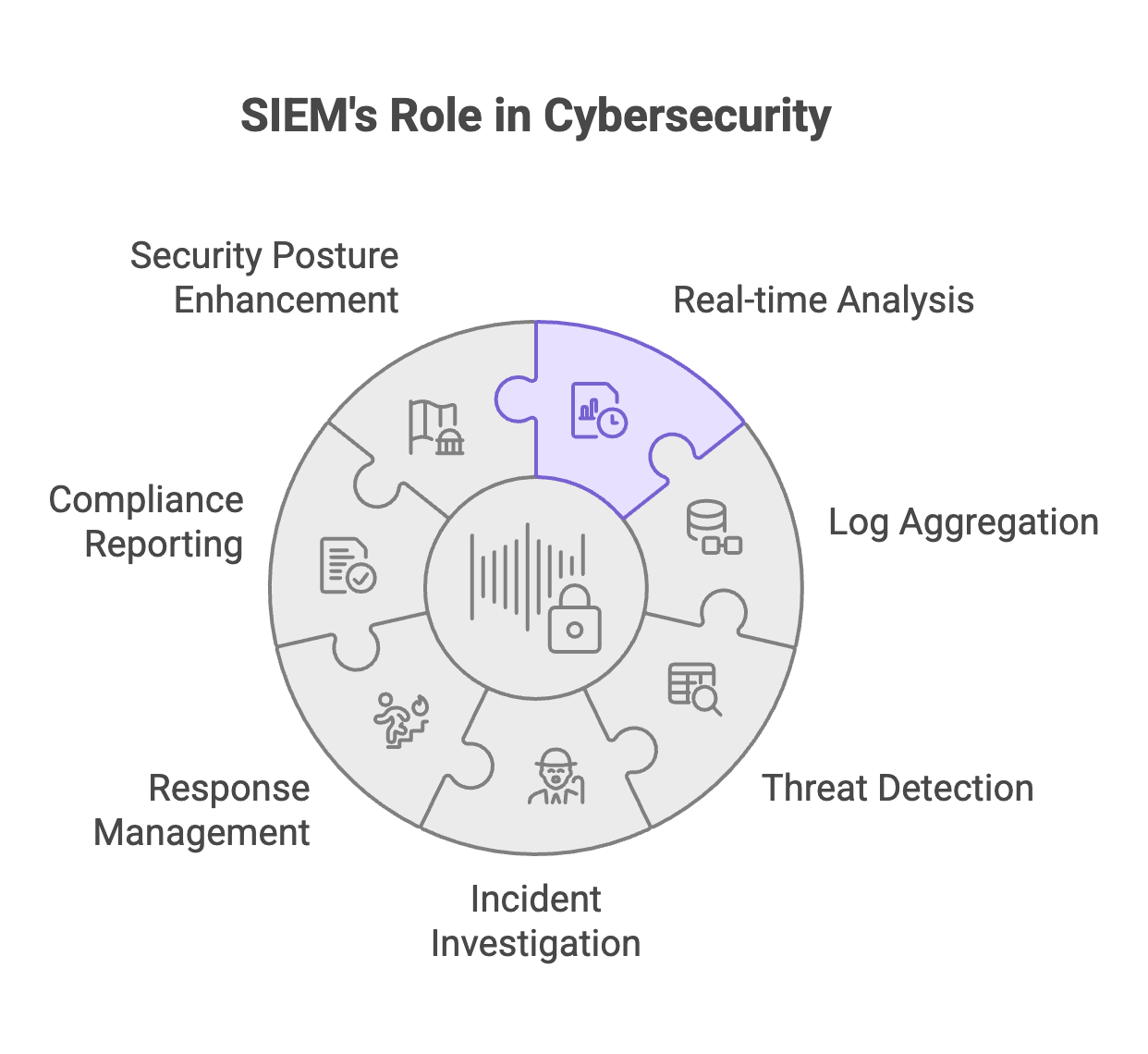
SIEM is software that pulls log and event data from across your IT environment, lines it up in a single schema, and watches it in real time for the patterns that mean trouble. It combines Security Information Management (SIM, the storage and reporting half) with Security Event Management (SEM, the live monitoring half). One place to spot an attack, investigate it, and decide what to do.
Understanding SIEM: The Foundation of Modern Security Operations
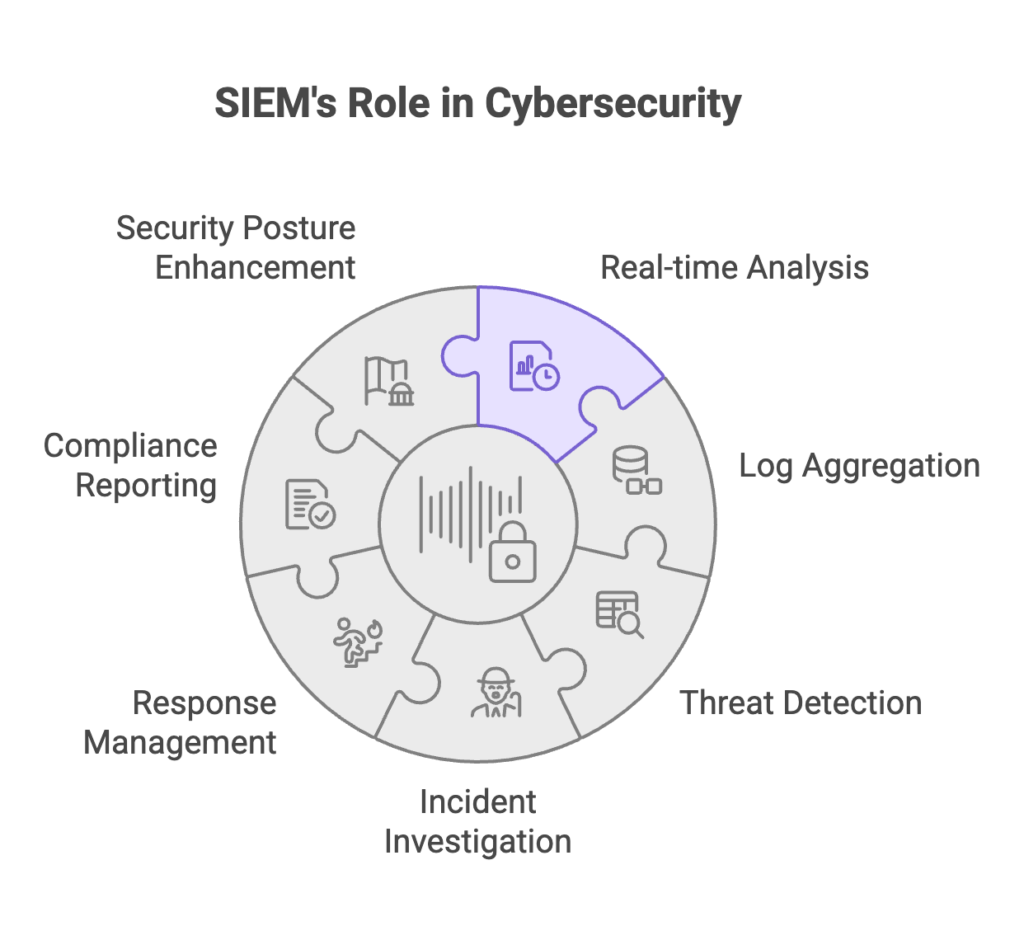
Two old acronyms welded into one product. SIM did log storage and reports. SEM did live monitoring and correlation. SIEM is both, sitting in front of every log source you care about, looking for the patterns that humans can’t spot at the speed they arrive.
The job is unglamorous. Pull logs from firewalls, servers, cloud accounts, identity stores, and endpoints. Normalise them so a Windows 4625 event and an AWS CloudTrail line can sit in the same query. Watch. Alert when something’s off. Think of it as the one pane an analyst stares at instead of forty separate consoles.
How SIEM Technology Works
Five steps. They’re always the same.
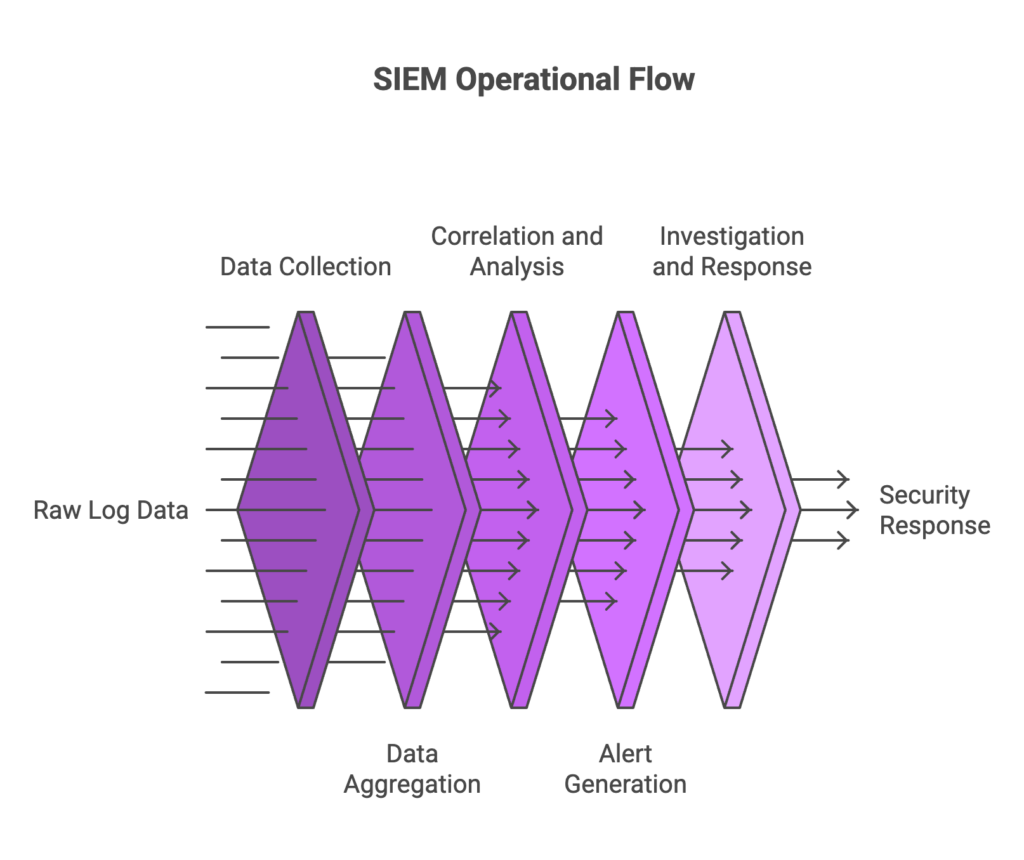
Data Collection. The platform pulls log and event data from network devices, security tools, applications, identity providers, and user activity. Continuously. No gaps if you can help it.
Aggregation and Normalization. Raw logs land in a dozen formats. SIEM rewrites them into one. A failed Windows login and a Palo Alto firewall block can now share a query.
Correlation and Analysis. This is the whole reason the product exists. Rules look for patterns. Five failed logins followed by a successful one from Hanoi at 3 AM isn’t five events. It’s one story.
Alert Generation. When the pattern matches a rule or trips a behavioural baseline, an alert fires, ranked by severity. The high ones page someone.
Investigation and Response. Analysts pivot through the timeline in the SIEM dashboard, pull adjacent events, and decide. Most modern platforms ship workflow tools so the response itself lives in the same place as the alert.
The IBM Cost of a Data Breach Report 2024 found that organisations using security AI and automation extensively saved an average of $2.22 million per breach. SIEM is the substrate those savings sit on.
The Evolution of SIEM: From Log Management to AI-Driven Security
It hasn’t always looked like this. A quick walk through three generations explains why modern SIEM feels nothing like a 2005 deployment.
Gen 1 (2000s). Mostly a compliance box. Collect logs, generate reports, satisfy HIPAA and PCI auditors. Analysis was manual. Alert fatigue was the norm long before the term existed.
Gen 2 (2010s). Real-time correlation arrived. Threat intel feeds went mainstream. Tuning was still a job and false positives still ran the day.
Gen 3 (now). Machine learning, behavioural analytics, cloud-native architectures. Unknown threats get flagged. Response actions run on their own. Hybrid and multi-cloud are first-class, not bolted on.
Today’s generation plugs cleanly into SOAR. Together they take the repetitive triage off analysts and free them up to do threat hunting that actually moves the needle.
10 Core Features of SIEM Systems in 2026
You should expect all ten of these from any enterprise SIEM you write a cheque for. If you don’t see them, ask why.
1. Real-Time Event Correlation
One failed login is nothing. Five failed logins, a successful one, then a process spawning PowerShell on a finance laptop is a story. Correlation builds the story across data streams in real time. Gartner pegs the speed-up at about 48% faster detection versus periodic log review.
2. Advanced Threat Detection
Signatures alone don’t catch much in 2026. You want a mix: signature, anomaly, and behavioural analytics. UEBA models learn what normal looks like for each user and flag the outliers. That’s how you spot account takeover and the insider who was always going to do this.
3. Centralized Log Management
SIEM has to swallow huge volumes of logs and let you find anything in them in under a second. Look for automated collection, tiered storage, and a search engine that doesn’t fall over at petabyte scale. Hot logs in fast storage, cold logs cheap, retrieval transparent to the analyst.
4. Automated Incident Response
Wire SIEM into SOAR and the platform can isolate an endpoint, block an IP, or disable an account without waking anyone up. Ponemon’s data: orgs with automated response contain breaches in 74 days on average, versus 108 for manual. That’s a month of dwell time gone.
5. Threat Intelligence Integration
Feeds turn a raw IP into a story. If your SIEM sees traffic to an address that was a Conti C2 last week, the analyst doesn’t need to look that up themselves. Context shows up next to the alert. Investigation goes faster.
6. Compliance Reporting and Audit Support
Compliance still pays for half the SIEMs out there. You want pre-built report packs for GDPR, HIPAA, PCI-DSS, SOC 2, and ISO 27001. The platform should also keep an audit trail of who accessed what, when, and from where, because that’s the question every external auditor asks first.
7. User and Entity Behavior Analytics (UEBA)
UEBA profiles every user and every device. When the marketing intern who works 10 to 6 starts pulling gigabytes from the data lake at 2 AM, UEBA notices. It’s the single best detection you have for compromised credentials and the rare-but-real insider.
8. Cloud and Hybrid Environment Support
You probably have logs in AWS, Azure, GCP, and a dozen SaaS products. A modern SIEM ships native connectors for all of them. Cloud-native deployments scale up and back down with data volume, which kills the old capacity-planning headache and keeps the bill predictable.
9. Network Traffic Analysis
Deep packet inspection and NetFlow analysis catch the things logs miss. Command-and-control beacons. Data exfiltration over DNS. Lateral movement on the east-west traffic that endpoint agents never see. Network visibility rounds out the picture.
10. Customizable Dashboards and Visualization
Analysts and CISOs need different views of the same data. The dashboard layer is where that happens. A good one shows the CISO posture at a glance and gives the analyst the drill-down without a ticket to engineering.
5 SIEM Tools for 2026
The right pick depends on your size, infrastructure, compliance pressure, and budget. There’s no single best. There are five platforms that show up on most shortlists in 2026.
1. Splunk Enterprise Security
Still the one to beat. Splunk’s analytics engine and the size of the app marketplace are why it stays on the shortlist even when the bill arrives.
Key Strengths
- Search and investigation are best-in-class.
- Hundreds of integrations in the app marketplace.
- Big community. Documentation that actually answers the question.
- Real ML capability through MLTK.
Best For: Large enterprises with complex environments and a real SOC.
Considerations: Cost. Operational overhead. Both significant.
2. Microsoft Sentinel
Cloud-native, Azure-flavoured, billed by ingestion. If your stack is Microsoft, Sentinel is the path of least resistance.
Key Strengths
- Native ties into Azure, M365, Defender, and Entra.
- AI and automation are built in, not bolted on.
- Pay-per-GB ingestion. Predictable for cloud-heavy stacks.
- Low ramp-up time for Microsoft shops.
Best For: Microsoft-heavy organisations and mid-to-large teams that want cloud-native from day one.
Considerations: Non-Microsoft sources need extra connectors. Value scales with how much Azure you already run.
3. IBM QRadar
SIEM with XDR bolted on. The flow-based architecture means you get strong network visibility without paying for full packet capture.
Key Strengths
- Flow-based design is efficient at scale.
- Out-of-the-box correlation rules are unusually good.
- Compliance report templates are deep.
- On-prem, cloud, hybrid, any of the three.
Best For: Compliance-heavy verticals and teams wanting one platform for SIEM plus XDR.
Considerations: The UI shows its age. There’s a learning curve to get to the advanced features.
4. Elastic Security (Elastic SIEM)
Built on the Elastic Stack. Open-source roots, commercial features on top. Engineers tend to love it. Less technical teams find it bare.
Key Strengths
- Open-source core. Commercial tier when you need it.
- Search speed is hard to beat.
- Plays well with the DevOps side of the house.
- Cost-effective if you have the in-house chops.
Best For: Mid-sized teams with strong engineering. Anyone wanting open-source flexibility.
Considerations: More hands-on than a turnkey product. Support depends on the licence tier you pay for.
5. Palo Alto Networks Cortex XSIAM
Palo Alto’s answer to “what comes after SIEM.” Heavy on automation, AI-driven by default, and tightly integrated with the rest of the Palo Alto stack.
Key Strengths
- Autonomous investigation and response are first-class.
- Tight integration with Cortex XDR and Prisma Cloud.
- Strong AI threat detection out of the box.
- Intelligent prioritisation cuts alert volume sharply.
Best For: Automation-first teams and organisations already on Palo Alto.
Considerations: Newer platform, still maturing. Premium pricing.
Where Hunto fits (Hunto publishes this blog): Hunto Autopilot is not a SIEM and does not replace any of the five platforms above. It runs AI agents on top of the SIEM you already have, taking on alert triage, enrichment and guided response so analysts spend less time on routine alerts. If you are choosing a SIEM, start with the list above; agents like ours come after.
SIEM Feature Comparison: Making the Right Choice
Side by side, the trade-offs look like this:
| Feature | Splunk ES | Microsoft Sentinel | IBM QRadar | Elastic Security | Cortex XSIAM |
|---|---|---|---|---|---|
| Deployment Options | On-prem, Cloud, Hybrid | Cloud-native | On-prem, Cloud, Hybrid | On-prem, Cloud, Hybrid | Cloud-native |
| Pricing Model | Data volume | Data ingestion | Events/flows | Data volume/features | Subscription |
| AI/ML Capabilities | Advanced | Strong | Moderate | Moderate | Advanced |
| Compliance Templates | Extensive | Strong | Extensive | Moderate | Moderate |
| Ease of Deployment | Complex | Simple | Moderate | Moderate | Simple |
| Integration Ecosystem | Extensive | Strong (Microsoft) | Strong | Strong | Growing |
| Automated Response | Via SOAR | Built-in | Via QRadar SOAR | Via commercial features | Built-in |
| Learning Curve | Steep | Moderate | Moderate | Moderate | Moderate |
| Best For | Large enterprises | Microsoft shops | Compliance-focused | Technical teams | Automation-focused |
Use the table as a screen, not a verdict. The only honest comparison is a proof of concept on your own logs.
Implementing SIEM: Best Practices for Success
Most failed SIEM projects didn’t fail because the product was bad. They failed at planning. Six things to nail down before the contract gets signed.
Define Clear Objectives and Use Cases
Decide what you want SIEM to do before you buy one. Threat detection, compliance, investigation, monitoring. Rank them by business impact. Write down five specific scenarios, things like “detect lateral movement from a stolen laptop” or “spot data exfil to an unmanaged storage service.” Those scenarios drive every rule you’ll write.
Inventory Your Data Sources
List every system that produces a security-relevant log. Rank them by value. Domain controllers, firewalls, VPN gateways, identity provider, those go in first. Resist the urge to ship every log. More data isn’t better. Noise is expensive and dilutes the signal.
Establish a Baseline and Tune Detection Rules
Default rules will bury you in false positives. Spend the first month watching what normal looks like in your environment before turning the aggressive detections on. ML models need that same training window. Tuning isn’t a one-time job. Put a recurring review on the calendar.
Build a Skilled Security Operations Team
SIEM amplifies analysts. It doesn’t replace them. Budget for training. If you don’t have the headcount, start with a managed SIEM provider and bring it in-house as the team matures.
Create Runbooks and Response Procedures
Decide once, do it the same way every time. Runbooks cover the common alert types: who investigates, what they check, when it escalates, what gets done. Every incident teaches you something. Fold the lesson back into the runbook.
Plan for Scale and Performance
Data volumes only go up. Design for that. Cloud SIEM scales elastically; on-prem needs capacity planning. Watch ingestion rate, query latency, and search times. When those slip, detection slips with them.
Integrating AI Agents with SIEM for Enhanced Security Operations
The volume problem is real. No human team can sift the thousands of alerts a modern SIEM throws off each day. cybersecurity AI agents are how SOCs are closing the gap in 2026, by handling the parts of the job that don’t need a human and surfacing only the ones that do.
Done right, agents multiply the analyst. Done wrong, they’re another product to babysit. Here’s where they earn their keep.
Alert triage and prioritisation. Agents pull context from threat intel, asset databases, and the team’s own incident history, score the alert by real risk, and bury the noise. The analyst sees the genuine threats first.
Automated investigation. When SIEM flags something, an agent can pull adjacent data, cross-check against past incidents, and hand the analyst a written timeline. Thirty minutes of click-through becomes thirty seconds of reading.
Threat hunting. Agents run continuous queries against SIEM data looking for the slow, patient indicators that don’t trip rules. Behavioural anomalies. Unusual data movements. The things APT groups bank on you missing.
Compliance monitoring. Agents watch the same SIEM data for policy violations, generate the reports, and flag drift before audit week. Less manual reporting. Fewer surprises.
Hunto AI ships purpose-built agents for the obvious roles: attack surface monitoring, threat intelligence, and the SOC analyst. They understand security workflow and work alongside whichever SIEM you’re already running.
The combined effect is the one CISOs care about. Teams that run AI agents on top of SIEM commonly report MTTD down by up to 70% and MTTR down by up to 80%. Same SIEM. Same logs. Faster outcome.
Common SIEM Implementation Challenges and Solutions
The problems are predictable. Knowing them ahead of time is half the fix.
Alert Fatigue
The problem: Thousands of alerts a day. Most are false. Analysts triage their way to numb, then miss the one that mattered.
The fix: Aggressive tuning in the first 90 days. ML baselines for behaviour. Tiered alerts with auto-handling for the low-severity ones. AI triage on top to filter noise before a human ever sees it.
Data Quality Issues
The problem: Inconsistent log formats. Missing timestamps. Half-shipped fields. Garbage in, garbage out.
The fix: Standardise logging across the estate. Normalise at the collector. Audit data sources monthly. Treat parsing rules as code, version them.
High Total Cost of Ownership
The problem: Licences priced on data volume balloon. Storage piles up. Staffing isn’t cheap either.
The fix: Retention tiers. Hot data only for what you actively query. Cold storage for the rest. Look at consumption-priced cloud SIEM. Consider managed services for the people side.
Skill Gaps
The problem: SIEM analysts are hard to find, harder to keep. Specialised skills across analysis, the specific platform, and rule development.
The fix: Train who you have. Certifications matter. Use managed services as scaffolding while the team grows. Automate the routine so analysts get to do interesting work.
Integration Complexity
The problem: On-prem, multi-cloud, SaaS, legacy. Every source has its own way of shipping logs, or no way at all.
The fix: Prioritise by security value, not by what’s easy. Vendor connectors first. Put an aggregation layer in front of SIEM if you have a long tail of weird sources. Buy platforms with deep integration libraries.
The Future of SIEM: Emerging Trends for 2026 and Beyond
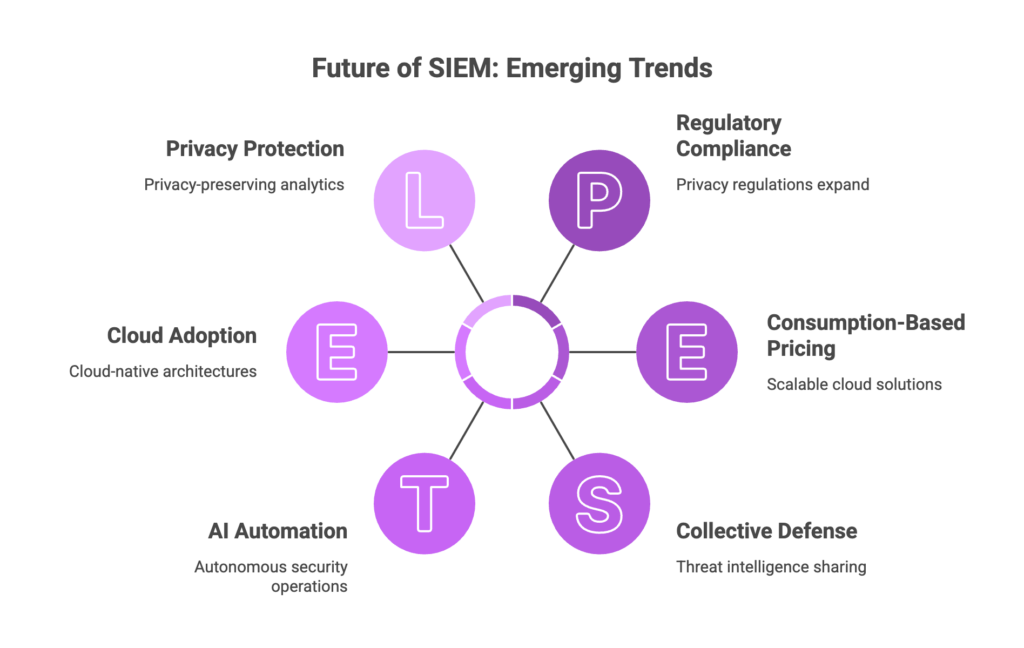
Five trends that will shape the next two years of SIEM purchasing.
XDR Integration
XDR is eating SIEM’s edges. Endpoint, network, cloud, app, the divisions blur as vendors add cross-domain correlation and automated response. Expect the SIEM/XDR distinction to mean less every quarter.
Autonomous Security Operations
AI is moving from assistant to operator. Future SIEMs detect, investigate, and respond with very little human input on routine work. Analysts shift up the value chain to hunting, strategy, and the genuinely novel attacks where human judgement still wins.
Cloud-Native Architectures
On-prem SIEM isn’t dead, but it’s losing share fast. Cloud-native is the default for new builds. Hybrid stays around for the data residency cases that aren’t going anywhere.
Privacy-Preserving Analytics
GDPR and its cousins make user-activity analysis legally interesting. Differential privacy and federated learning let you run security analytics without parking PII in a single warehouse. These techniques go mainstream as the regulation map gets harder.
Threat Intelligence Sharing
Automated, anonymised intel exchange between SIEMs across organisations is finally happening. Collective defence pays. Your platform should be a participant, not a silo.
Get ahead of these and you’ll be having a different conversation in 2027.
Conclusion
SIEM grew up from a compliance tool into the heart of modern security operations. Real-time correlation, behavioural analytics, threat intel, automated response, that combination is the strongest single defence available against the threats most teams actually face.
The product choice matters less than the operation. Splunk, Sentinel, QRadar, Elastic, or Cortex XSIAM can all work. None of them will save you if the use cases aren’t defined, the data sources are dirty, or nobody owns tuning. Pick the one that fits your stack and your team, then put the work in.
And if you’re wondering whether SIEM is still the shape of the answer, take a look at Hunto AI. The next generation of SOCs runs on AI agents sitting on top of SIEM data, doing the routine work that ate analyst hours for two decades.
Frequently Asked Questions About SIEM
What is the difference between SIEM and SOAR?
SIEM tells you something’s wrong. SOAR does something about it. SIEM collects, correlates, and detects. SOAR orchestrates the response across the tools you own. Modern SOCs run both. A lot of vendors now ship them as one product, but the two jobs are still distinct.
How much does a SIEM system cost?
It varies, a lot. A small business on cloud SIEM might spend $10k to $50k a year. Mid-market lands between $100k and $500k once you add licences, storage, and people. Large enterprises run into the millions. Consumption-priced cloud SIEM is more predictable than perpetual licences, but the real cost is always staff and tuning. Factor those in or the budget will lie to you.
Can small businesses benefit from SIEM?
Yes. Cloud SIEM with consumption pricing is genuinely accessible now, and a managed SIEM service gives a small org enterprise-grade monitoring without the headcount. Compliance work alone (PCI, HIPAA) often makes SIEM unavoidable. The trick is to pick a product sized for you, not a stripped-down Fortune 500 deployment.
How long does SIEM implementation take?
A basic cloud SIEM with a handful of data sources can be useful in two to four weeks. A full enterprise deployment is three to six months for the initial rollout, plus ongoing tuning. Clear objectives, a documented data-source inventory, and a dedicated owner shave months off. SIEM is never “done”, it keeps evolving with the environment.
What skills do SIEM analysts need?
Strong fundamentals first. Network protocols, operating systems, the attack patterns of the day. Add fluency in the platform’s query language, SPL for Splunk, KQL for Sentinel, EQL for Elastic. Pattern recognition matters more than memorisation. Compliance knowledge helps for audit-heavy industries. Communication closes the loop: analysts who can write a clean incident report are worth their weight. Hunto AI can take routine triage off the table so junior analysts spend their time on the investigations that build expertise.
